Picking between softshell fabrics vs waterproof laminates for fishing jackets sounds simple. Then you're standing in a cold drizzle at 5am, three hours into a session — and your jacket has already made the call for you.
Both materials have real strengths. Both have real trade-offs too. Most fishing jacket manufacturers skip over those trade-offs in their product pages.
The differences run deeper than a waterproof rating on a spec sheet. Think breathability under load, stretch geometry, noise on the water, and how each fabric holds up after a full season of hard use.
Sourcing at scale or building a single piece? This breakdown cuts through the marketing noise. You'll see where each material wins, where it falls short, and which scenarios call for which choice.
Material Construction And Technical Build
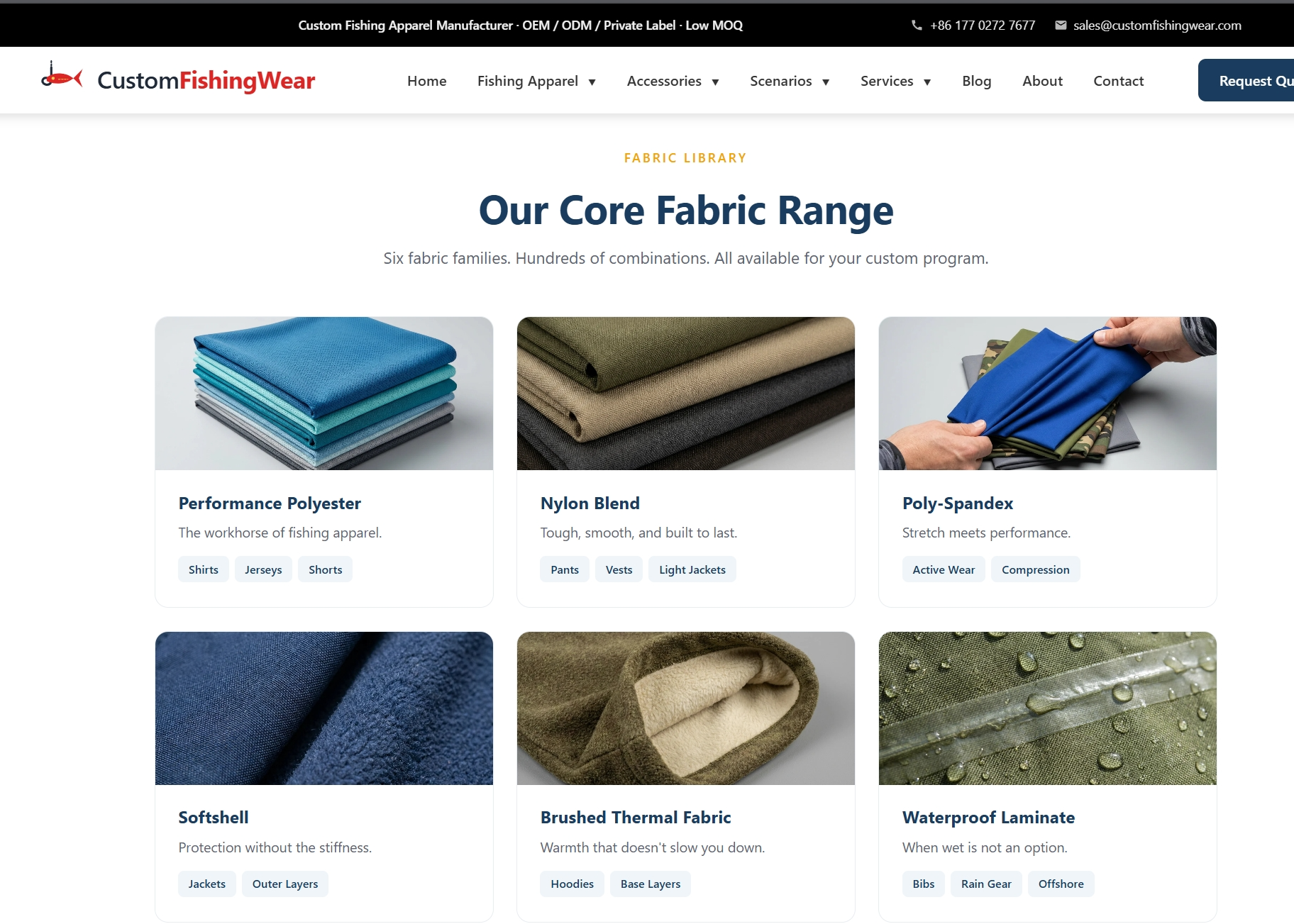
The fabric tells you everything — if you know how to read it.
Softshell starts with a tightly woven polyester or nylon face in the 20–40 denier range , blended with 5–10% spandex or elastane . That spandex content gives softshell its signature multi-directional stretch and mechanical recovery. The inner side uses brushed fleece or micro-grid fleece — polyester-based, ranging from 160 gsm on lighter aerobic builds to 320 gsm on winter-grade pieces .
Most performance softshells are 2-layer or 3-layer bonded composites . The 3-layer version adds a thin ePTFE or PU/TPU membrane between the face and the fleece backing. That membrane handles wind resistance and pushes breathability toward 5,000–10,000 g/m²/24h MVTR . Waterproof ratings land between 3,000–5,000 mm — fine for mist and light rain, but not sustained downpours.
Waterproof laminates follow a different logic altogether.
The construction options are 2L, 2.5L, and 3L :
2L : face fabric bonded to membrane, with a loose interior lining added as a separate layer
2.5L : membrane back protected by a printed resin pattern instead of a full lining — lighter, packable
3L : face, membrane, and backing laminated into one self-lined unit — the gold standard for technical durability
The membranes — PU, TPU, hydrophilic PU, or ePTFE — block liquid water while passing vapor through. High-performance laminates target ≥10,000 g/m²/24h MVTR and >10,000 mm hydrostatic head . Quality laminates need a peel strength of 2.5–4.0 N/25 mm . That's what stops delamination through repeated wear and washing.Experienced fishing jacket OEM/ODM services teams usually prioritize seam construction before fabric selection.
For fishing jackets, one structural detail stands above the rest: seam sealing . Softshell's elastic build makes full seam taping unreliable. Hot-air tape on stretch panels breaks down and delaminates over time. Waterproof laminate shells are built for critical or full seam sealing . That's what creates a true barrier in a sustained downpour.
DWR finish sits on top of both systems. The mechanism is simple — microscopic vertical structures on the face fabric push water into beads instead of letting it spread and soak in. No functional DWR means even a high-rated membrane loses breathability. The wet face fabric clogs vapor pathways and shuts down moisture transfer. Both systems depend on DWR. Neither one can replace it.
Waterproof Ratings And Weather Resistance
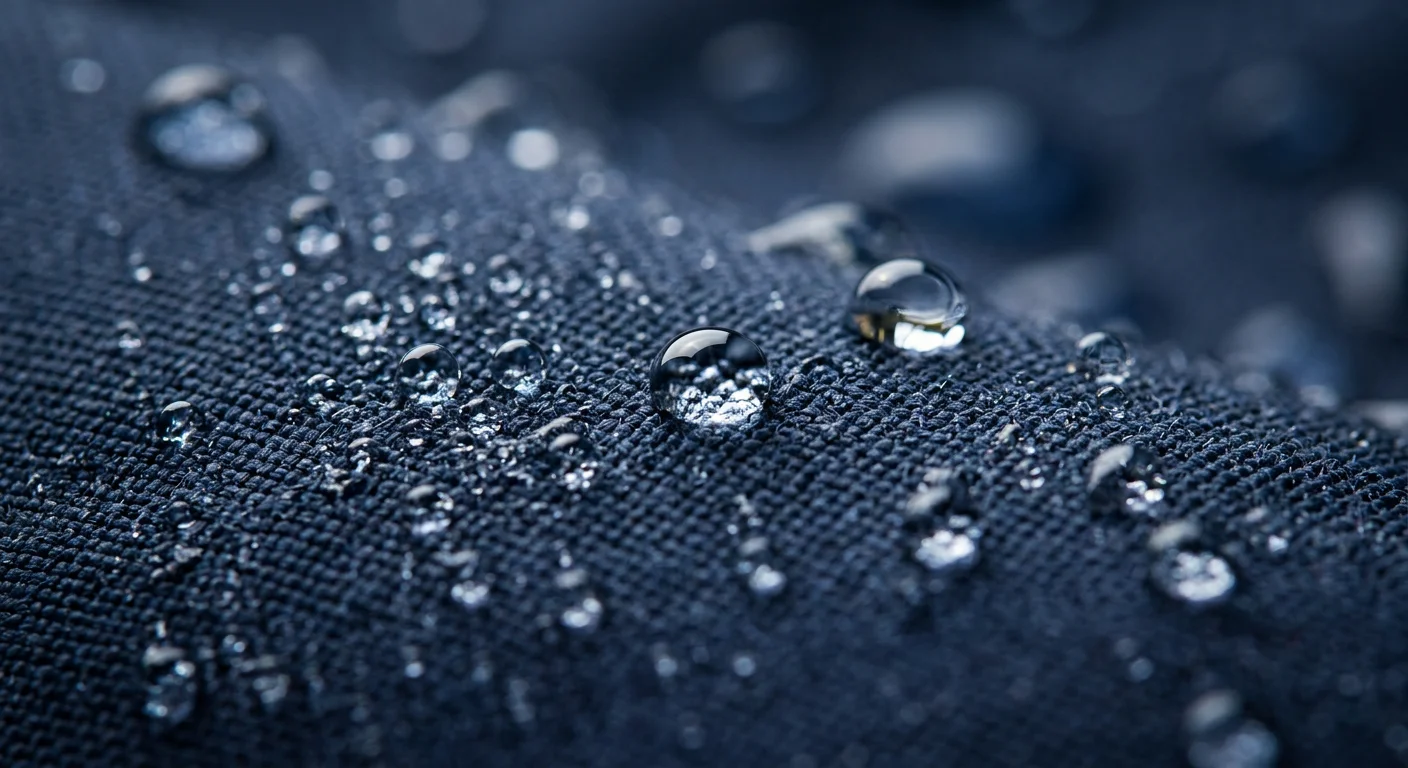
The number on the spec sheet is hydrostatic head — measured in millimetres. It tells you more about a jacket's real-world limits than any marketing headline.
Here's what those numbers mean in the field:
HH Rating | Classification | Real-World Fit |
|---|---|---|
0–1,500 mm | Water-resistant only | Light mist, brief exposure |
1,500–5,000 mm | Low-grade waterproof | Light to moderate rain, short duration |
5,000–10,000 mm | Very waterproof | Moderate rain, standard protection |
10,000–15,000 mm | High waterproof | Heavy rain, wet snow, serious rainwear |
≥20,000 mm | Full waterproof | Sustained storms, wave spray, high-contact use |
Where Softshell Falls On That Scale
Most softshell jackets land in the 1,500–5,000 mm band. Better coatings push some toward ~8,000 mm — but that's still below the threshold that matters.
The problem isn't the lab number. It's the mechanism.
Softshell waterproofing runs on DWR . That's it. DWR fresh out of the box beads water off the face fabric well. Once DWR wears down — or gets overwhelmed by prolonged rain — the face saturates . Vapor transmission collapses. The jacket goes cold and clammy fast.
Pack strap pressure, sitting on a wet gunwale, kneeling on a wet deck — any sustained contact point speeds up leak-through. Below 10,000 mm , the verdict is clear: water-resistant, not rainproof .
Where Waterproof Laminates Start
10,000 mm HH is the accepted floor for serious rainwear. Most standard laminate shells — 3-layer PU or ePTFE builds — sit in the 10,000–15,000 mm range. That handles sustained heavy rain and typical alpine conditions.
For fishing, the numbers shift harder toward the top of the scale:
Minimum 10,000 mm for moderate rain and occasional spray
20,000 mm for all-day sessions in driving rain or coastal conditions
28,000+ mm — Gore-Tex Pro and equivalent heavy-duty laminates — for wave spray, prolonged storms, and continuous high-pressure water contact
Here's the key difference from softshell: the face fabric on a laminate shell can wet out, and the membrane underneath still holds . The waterproof barrier doesn't need the surface to stay dry. That structural advantage is what separates laminate shells from softshells in a sustained downpour.
For softshell fabrics vs waterproof laminates for fishing jackets , the rating gap is not small. You're looking at 4,000–5,000 mm versus 10,000–20,000+ mm . Those are two separate protection categories — not two points on the same scale.
Breathability And Moisture Management
Breathability is where the gap between these two systems gets interesting — and where most buyers make the wrong call.
The key metric is MVTR (Moisture Vapor Transmission Rate) , measured in g/m²/24h. Higher numbers mean faster sweat vapor export. Less internal condensation. Less of that suffocating, damp-against-skin feeling after an hour of hard work on the water.
Here's what the numbers look like:
Shell Type | Construction | HH (mm) | MVTR (g/m²/24h) |
|---|---|---|---|
Softshell | DWR-only woven | 5,000–8,000 | 20,000–30,000 |
Softshell | Thin PU film + DWR | 8,000–12,000 | 10,000–18,000 |
Laminate | 2.5-layer PU | ≥15,000 | 15,000–20,000 |
Laminate | ePTFE membrane | ≥30,000 | 22,000–28,000 |
How Softshell Moves Moisture
Softshell's open weave structure doesn't fight vapor — it lets vapor pass straight through. A DWR-only woven softshell can hit 20,000–30,000 g/m²/24h . That's often 2× the output of a comparable laminate at similar weight.
The construction does the work. The outer woven face sheds surface water. The lofted or knit inner layer spreads sweat out and speeds up evaporation away from your skin. Cold air stays out. Vapor gets out. That combination is why softshell feels comfortable during sustained casting, hiking to a spot, or working a set of oars hard.
You're moving hard in cool, windy conditions. Your body generates real heat and needs to dump it fast. Softshell's breathability advantage is measurable — you feel it, not just see it on a spec sheet.
There's a clear weak point, though. Once DWR degrades , the face fabric soaks up water and clogs those vapor pathways. MVTR drops fast. The jacket that felt breathable at dawn turns into a wet compress by midmorning.
How Laminates Handle Moisture
Waterproof laminates move vapor through a different mechanism. Microporous structures pass vapor molecules while blocking liquid water. Hydrophilic non-porous TPU films push vapor through by molecular diffusion, driven by temperature and humidity differences between inside and outside.
That dependency on gradients matters on the water. Laminate breathability works best with your body temperature up and the outside air cool and dry. Warm, humid conditions change the picture. Low-intensity fishing keeps metabolic heat low. That gradient flattens. Vapor export slows. The clammy feeling builds.
MVTR comfort bands for laminates break down this way:
5,000–10,000 g/m²/24h — fine for standing still or low-effort use; you'll notice clamminess under a sustained load
10,000–15,000 g/m²/24h — solid for moderate activity; still struggles in high-humidity or hard-effort conditions
15,000–25,000+ g/m²/24h — high-end ePTFE and advanced PU builds; real breathability without giving up the water barrier
Many fishing apparel wholesalers compare MVTR and HH together before selecting new outerwear lines.
The Real Trade-Off
Softshell pushes high MVTR with moderate HH . Laminates push high HH with acceptable MVTR . Neither system wins on both at the same time.
The breathability decision for softshell fabrics vs waterproof laminates for fishing jackets comes down to two things: exertion level and weather intensity.
Moving hard in cool, wet-but-not-torrential conditions? Softshell's vapor output wins on comfort. Sitting a blind or anchored through driving coastal rain — where staying dry matters more than staying cool — the laminate's sealed barrier earns its breathability trade-off.
Stretch, Mobility And On-Water Comfort
Fabric feel is something you notice in the first five minutes — and keep noticing for the next eight hours.
Softshell's mobility advantage comes down to one number: spandex content . Performance softshell fishing jackets blend 15–25% elastane into the nylon or polyester base. That's enough to deliver genuine 4-way stretch — movement in both the warp and weft directions at once. The real mobility benchmark is ≥50% extension in both directions . Most quality softshell constructions hit that mark.
What that means on the water:
- A full casting stroke won't pull at the shoulders
- Deep crouching to net a fish won't bind at the hips
- Torso rotation — common in fly fishing and kayak angling — happens without the jacket pushing back
The fabric follows your body through every plane of movement instead of fighting it.
Weight range matters here too. Most performance softshells land in the 250–320 GSM band. Heavy enough for coverage and warmth. Light enough that the material won't drag or build fatigue over a long session. Articulated panel cuts and inseam gussets take this further. They keep fabric close to the body at rest while still letting your joints move fully under load.
Waterproof laminates work on a different principle. Most use polyester or nylon base fabrics with minimal elastane — often zero. Where stretch exists, it's usually 2-way rather than 4-way . The structured drape holds shape well. It covers you and holds up over time. But push into an aggressive casting angle or reach hard across a gunwale — that structure pushes back.
The On-Water Feel Difference
Stretch numbers only tell part of the story. Spec sheets miss the tactile side.
Softshell's nylon-spandex surface has a soft hand and smooth face . That matters during repetitive motion — rowing, paddling, repeated casting. A rough or stiff exterior creates friction against underlayers. That friction builds fatigue over hours. The surface stays quiet too. No crinkle. No noise that spooks fish in shallow water.
DWR hydrophobic finishes on softshell stop the fabric from soaking up water and going heavy. After a wave hits or a wading misstep, you stay drier, lighter, and less restricted . Laminates at the same weight can't match that comfort margin.
For softshell fabrics vs waterproof laminates for fishing jackets , the trade-off is straightforward. Softshell moves with you at every joint angle. Laminates hold their shape around you. Push hard all day with constant movement and shifting posture — that difference adds up. Your shoulders will know it by afternoon.
Noise Profile And Tactile Feel
On still water at dawn, fabric noise travels. A single crinkle from your sleeve can scatter fish before your fly ever lands.
Softshell and waterproof laminates differ here in ways no spec sheet captures.
Softshell is quiet by construction. The stretch-woven face — 40–70D nylon or polyester — pairs with a brushed 20–30 g/m² knit backer. Together, they absorb kinetic energy instead of releasing it as sound. Raise your arm through a full casting stroke. The fabric folds. No snap. No crinkle. Just a muted rustle that fades within a few meters. Hunters rely on softshell for stalking and glassing. The same logic applies to bank fishing and shallow-water wading.
Waterproof laminates work differently. The continuous TPU film — 15–25 μm thick — adds structural stiffness. Panels can't absorb that stiffness without making noise. Rapid movements at the elbows, shoulders, and hips produce a sharp, high-frequency crinkle. Heavier face fabrics (≥50D) and thicker membranes make that sound even louder. Higher glue coverage — toward 60% — makes it worse. It locks the layers together and removes what little sound-damping the fabric had.
The feel difference matches the sound difference:
Softshell : soft, textile-like, drapes and conforms. It feels like a dense knit — unrestricted, warm-backed, almost casual against your skin.
Waterproof laminate : crisp, structured, cool to the touch until body heat builds up. That "snap" you feel crumpling it in your hand? You'll notice it in every movement too.
Fishing jacket Manufacturers looking to close the gap have a clear path. Use thinner membranes (15 μm), lower-denier stretch faces, and reduced glue coverage (40–50%). These changes bring a laminate shell much closer to softshell-level quietness — without giving up the waterproof barrier.
Durability Under Prolonged Wet Exposure
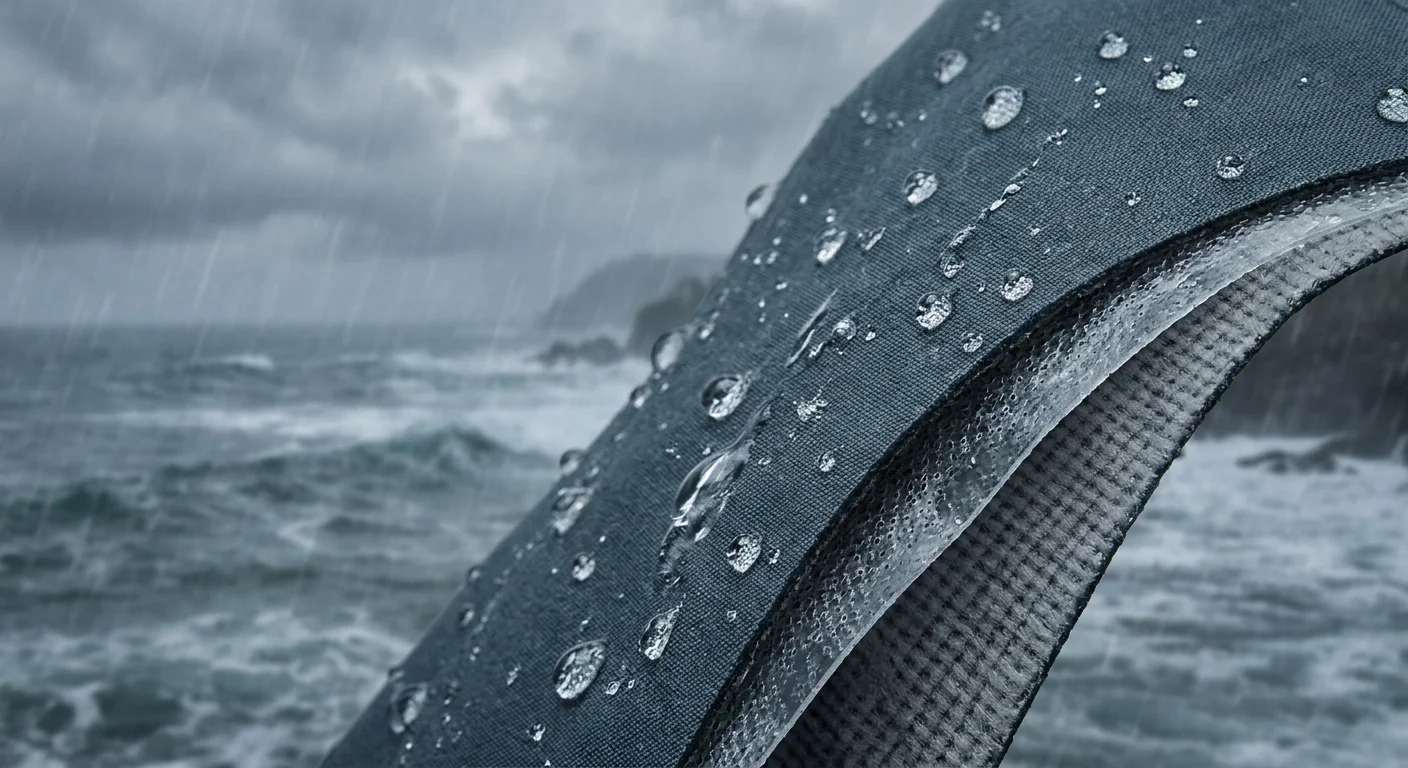
Three hours into a coastal session, the rain still hasn't let up. That's where fabric marketing stops and material physics takes over.
The durability gap between softshell and waterproof laminates in sustained wet conditions isn't minor — it's structural.
How Softshell Fails Over Time
Softshell's waterproofing has one point of failure: DWR . Not the weave. Not the backing. The coating on top.
Fluorine-free DWR — now the industry standard — keeps beading for about 10–15 machine washes . After that, the face fabric stops shedding water and starts soaking it up. The face saturates. Water pressure on the layer beneath it rises. Effective HH can drop by 20–30% on lower-density fabrics under 30D. Skip DWR renewal long enough, and total waterproof performance can fall by up to 70% — even with the membrane fully intact underneath.
That's not where the problem ends. Softshell's brushed or fleece interior — the same feature that makes it warm and comfortable — acts like a sponge once wet-through hits. Insulation collapses. Drying time stretches to hours in cold, humid conditions. In prolonged exposure, that's not just discomfort — it's a hypothermia risk.
The numbers show the failure threshold clearly:
- 3,000–5,000 mm HH : fine for light showers; wet-through is likely in sustained rain
- 5,000–10,000 mm HH : handles moderate rain; still borderline in long storms
- ≥10,000 mm HH : the accepted minimum for storm-durable performance
Most softshells never hit that third tier.
How Laminates Hold Under Pressure
Waterproof laminates work from a different failure model. The membrane itself — rated at ≥10,000 mm HH , and 20,000+ mm for high-contact fishing conditions — doesn't break down from rain. Quality laminates can block liquid water up to 172 kN/m² (≈17,500 mm water column) with no measurable flow through the functional layer.
Long-term membrane integrity is testable and verifiable. Industry durability benchmarks require ≥80% HH retention after 70°C × 7-day hot water aging . That's hydrolysis resistance — the membrane holds under conditions that mimic years of real use.
Laminate garments that fail under prolonged exposure? The membrane is almost never the culprit. Failures trace back to:
- Seam tape delamination — from age, contamination, or a manufacturing error
- Mechanical damage — puncture or abrasion to the face fabric or the membrane itself
This is why ≥40D face fabric matters. Lighter denier fabrics let water press more directly against the membrane under load — pack straps, kneeling on a wet deck, leaning against a gunwale — and that cuts effective HH by 20–30% at contact points.
Full seam sealing isn't optional here. Critically taped seams — partial coverage of key zones only — fall short for prolonged exposure. The membrane holds. An unsealed seam won't.
The Maintenance Variable Both Systems Share
DWR maintenance matters for both materials, but the stakes aren't equal. For softshell, skipping DWR renewal speeds up wet-through across the entire garment. For laminates, degraded DWR increases surface wet-out, pushes water pressure onto seams, and cuts breathability — but the membrane underneath still blocks liquid water.
The care routine is the same for both. Wash it dirty. Heat-dry on low to reactivate DWR. Use a spray-on or wash-in DWR renewer once beading stops forming. The difference is what you're actually protecting. On a softshell, you're maintaining the only waterproof barrier in the garment. On a laminate, you're keeping a system sharp that already has a second line of defense built in.
For softshell fabrics vs waterproof laminates for fishing jackets judged on prolonged wet exposure, the answer is straightforward. Softshell is built for comfort in variable conditions. Laminates are built to keep water out when conditions don't quit.
Ideal Fishing Scenarios And Use Cases
Material choice gets real the moment you lock in a location, a forecast, and a full day on the water.
Here's how each system maps to real fishing conditions.
Where Softshell Makes Sense
Softshell earns its place in specific, well-defined conditions — not all of them.
Cool, windy bank sessions with minimal rain. Shore and pier fishing in strong wind with dry-to-drizzly weather is softshell's home territory. The fabric blocks windchill hard. Breathability stays high. You're casting, repositioning, covering ground — softshell keeps pace without trapping sweat.
Mobile, high-output freshwater fishing. Stream wading, stalking carp along a bank, hiking several kilometers to a remote lake — these are aerobic activities first, fishing second. Softshell balances wind and light water resistance with the vapor output your working body needs. Put a waterproof laminate in the same scenario and it turns into a sweat chamber fast.
Shoulder-season rivers and light coastal day trips. Spring and fall stream fishing with passing showers, or inshore harbor sessions where you can duck under cover if weather turns — softshell holds up as a primary outer layer. It handles passing rain and sea spray well. It does not handle several back-to-back hours of sustained rain.
One practical note: softshell layers well under a laminate shell. A storm rolls in — the softshell becomes your comfort and insulation layer. The laminate goes on top and handles the rain.
Where Waterproof Laminates Are Non-Negotiable
Sustained rain changes the equation. No gray area.
All-day sessions in heavy or continuous rain. The forecast shows rain from morning through evening — open reservoirs, exposed coastal banks, large lake shores — you need a 10,000 mm minimum as the floor. Below that, wet-through is a matter of when, not if. For sessions running four hours or longer in driving rain, 15,000–20,000 mm is the more realistic target.
Offshore and open-boat fishing. Wave spray, deck wash, and sudden squalls hit differently than rainfall alone. The water comes from multiple angles under real pressure. Taped seams and 15,000 mm+ waterproofing aren't a premium — they're the baseline. Budget rain gear below 10,000 mm leaks under continuous spray. It's not a close call.
Cold, wet marine environments. North Atlantic winter trolling, Pacific Northwest salmon seasons, Great Lakes storm conditions — these environments demand 20,000+ mm waterproofing with equivalent breathability to match. Poor rain protection in cold-wet conditions becomes a hypothermia risk over a long session.
The One Practical Rule
Conditions borderline — forecast uncertain, session running long, no shelter nearby? Advice across fishing and outdoor communities points one direction: go with the laminate .
Softshell is the right call with weather on your side. Laminate is the right call when it might not be.
Key Sourcing Parameters And Specification Benchmarks
Specification sheets don't lie — but they tell the truth only if you know which numbers to demand.
Sourcing fishing jackets around softshell fabrics vs waterproof laminates means the construction tier drives everything else: performance targets, testing obligations, certification requirements, and even the zipper spec on a pocket flap.
Layer Construction And Minimum Performance Targets
Each laminate tier has its own sourcing floor:
Construction | Waterproof (ISO 811) | Breathability (g/m²/24h) | Ret (ISO 15496) |
|---|---|---|---|
2L PU/TPU | 10,000–15,000 mm | 8,000–12,000 | 9–15 |
2.5L | 15,000–20,000 mm | 10,000–20,000 | 6–12 |
3L (full backer) | 20,000–30,000 mm | ≥20,000 | <6 |
Softshell (DWR only) | 5,000–10,000 mm | >15,000 | <6–8 |
For serious fishing applications, 3L laminates at ≥20,000 mm / 20,000 g/m²/24h are the real performance floor. Anything below that is a trade-off. Name it clearly in your brief.
Face Fabric Composition
Polyester stretch shells : 85–95% polyester / 5–15% elastane for 4-way stretch; 40–75D for 2.5L builds, 75–150D for durable 3L construction
Nylon face : 85–95% nylon / 5–15% elastane for high-tear technical shells; ultralight runs 20–40D , workwear-grade runs 70–140D
Softshell backer : 100% polyester microfleece at 140–250 gsm — lock down this range in your spec. Fishing Jackets suppliers will quietly drop the weight if you don't.
Construction Details Worth Locking Down
Seam tape — specify width and coverage together. Standard shells use 20 mm tape . Technical outerwear steps up to 22–24 mm . Full waterproof integrity on fishing jackets means 100% seam coverage on shoulders, hood, and sleeves at minimum . 3L builds need full seam sealing across the entire garment. Tape chemistry must match membrane chemistry — PU tape goes with PU membrane, TPU with TPU.
Waterproof zippers — #5 or #8 reverse-coil, PU-coated for front closures; #3 for pockets. Your spec should call out laminated zipper garages, bartack reinforcement, and zero needle penetration through zipper tape in critical zones.
DWR — C0/PFC-free is now the standard sourcing benchmark. Ask for bluesign or OEKO-TEX compliance documents alongside the DWR spec. C6 still shows up in some markets, but most performance outerwear buyers have dropped it.
Certification Requirements
Don't take performance claims at face value. Ask for test documentation on every point:
ISO 811 — waterproof rating; get the lab report with a stated minimum (≥10,000 mm for fishing-grade laminate)
JIS L 1099 / ISO 15496 — breathability; specify both the g/m²/24h floor and the Ret ceiling
OEKO-TEX Standard 100 — ask for the current certificate number and validity date on all fishing jackets supplier offers
bluesign approved — applies to face fabric and membrane suppliers; this confirms controlled chemistry at the mill level
GRS certification — recycled polyester content in your spec means you need ≥50% verified recycled content backed by a current GRS certificate
Common Industry Claim Pitfalls And Verification Points
Marketing language moves faster than test data. "All-weather," "marine-ready," "premium waterproof" — these phrases appear on softshell and laminate jackets alike. Most have nothing measurable behind them.
Three pitfalls come up when comparing softshell fabrics vs waterproof laminates for fishing jackets :
Misclassified waterproofing. A jacket rated at 1,500–5,000 mm HH is water-resistant. Not waterproof. Not rainproof. Pairing that rating with "waterproof" in the product copy makes the claim wrong. Look at the actual hydrostatic head figure and construction method — not the adjective the marketing team picked.
Incomplete seam disclosure. Fabric ratings mean nothing without sealed critical seams. Partial taping breaks down in sustained rain. Ask for a seam-sealing coverage map. It should identify tape type and exact coverage across the hood, shoulders, zippers, and hem.
Breathability used to hide weak wet-weather performance. A high MVTR number does not make up for a 4,000 mm HH rating during a coastal downpour. You still get soaked.
Minimum verification checklist:
- Third-party lab report — it must state the test method, mm rating, and g/m²/24h value
- Post-wash DWR retention data — initial spray results tell you nothing about long-term durability
- Seam-sealing documentation from an external source, not a self-declaration
- Full claims package: lab name, test date, SKU, and lot number tied to the exact article sold
No file? The claim has no backing. Don't accept it.
Conclusion
Softshell fabrics vs waterproof laminates for fishing jackets — the real question is simple: where do you fish? How bad does the weather get out there?
Softshells feel great. They move well and breathe well. But they handle rain — they don't block it. Laminates take on heavy downpours without flinching. The trade-off? You'll need to think more about layering and airflow. No single material is the right choice for every situation. Both are built for specific conditions.
Smart sourcing means looking past the marketing numbers. You need to:
Verify HH ratings after real wash cycles — not just out of the box
Cross-check MVTR claims against the actual jacket construction
Match stretch percentages to your casting style and range of motion
Don't let habit or brand loyalty drive your jacket decision. Ask for fabric data sheets, sample swatches, and field-test reports before you commit to a production run.
The angler — or buyer — who pays attention to the details never gets caught off guard on the water.Need custom fishing jackets? Request technical samples before placing a bulk order.