Most anglers don't lose a fishing trip to bad weather or slow bites. They lose it to gear that wasn't built for saltwater. That cotton shirt soaks through in twenty minutes. The "waterproof" jacket rusts out at the seams after one offshore season. The synthetic pullover traps heat like a greenhouse — while you're baking under near-shore glare bouncing UV from every direction.
Saltwater is a punishing environment. It exposes cheap design decisions fast. The good news: six clear features separate purpose-built custom saltwater fishing apparel from dressed-up hiking wear. Know those six features, and you stop wasting money on the wrong kit. What follows isn't a gear roundup. It's a practical framework built from real time on the water — something you can use straight away in your next buying decision.
UPF Sun Protection Thresholds and Near-Shore Glare Mitigation
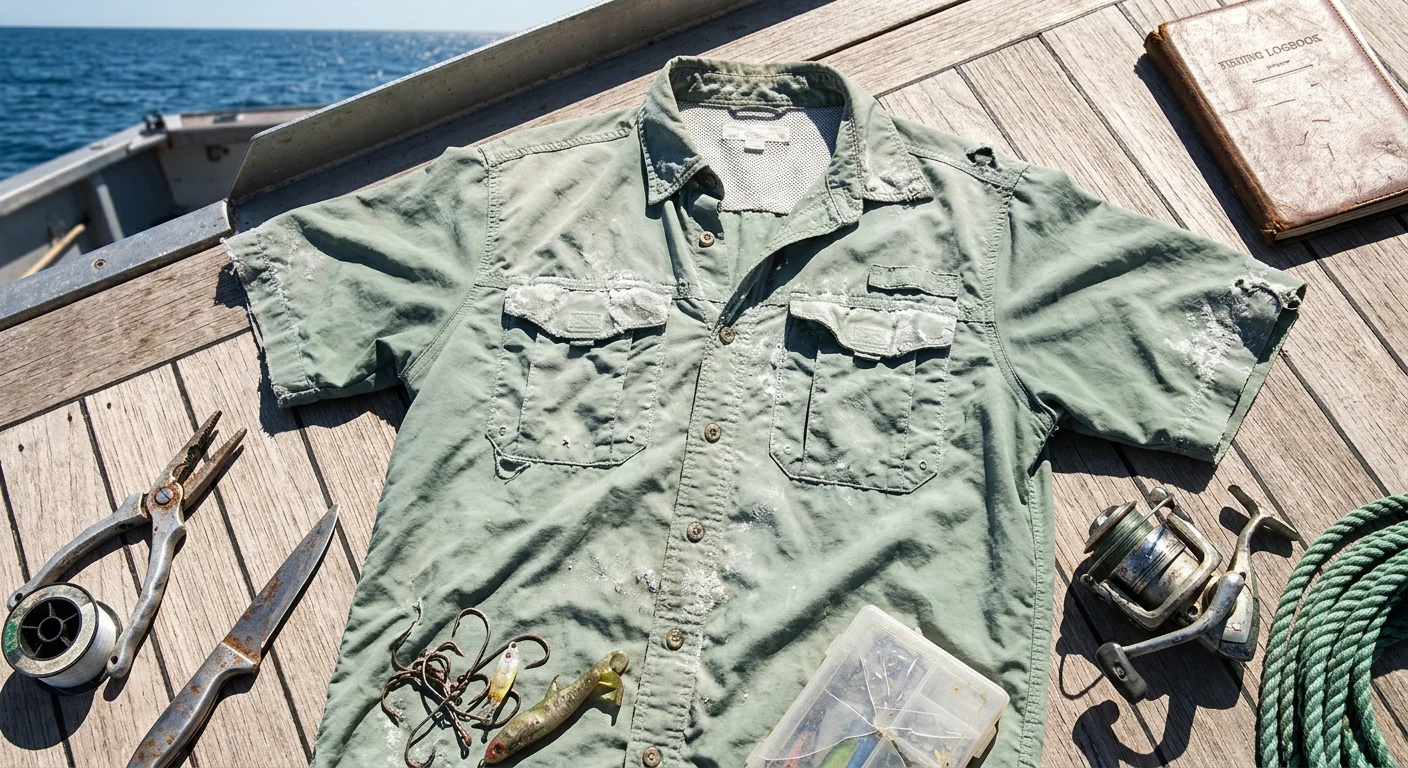
Most anglers don't think about the tag until they're already burned. That number matters far more than any marketing copy around it.
UPF — ultraviolet protection factor — is the textile version of a structural load rating. It tells you what percentage of UV radiation passes through the fabric to your skin. UPF 50+ means less than 2% of UV gets through. That's the number you want. Everything below it is a trade-off, and in a near-shore saltwater environment, trade-offs stack up fast.
Why UPF 30 Isn't Enough on the Water
The standard outdoor recommendation — UPF 30 to 40 — works fine on a hiking trail or a golf course. It doesn't work on the flats. Here's why.
Near-shore fishing puts you inside a ring of reflective surfaces. Water bounces UV back up at you. White sand does the same. You're not just catching rays from above. You're catching them from below and from the side too. Morning and evening low-angle sun hits hardest — glare comes at you from every direction. That reflection-heavy environment is the condition where lower UPF ratings fall apart.
The math is unforgiving:
UPF 30 → transmits ~3.3% UV through the fabric
UPF 40 → transmits ~3.5%
UPF 50+ → transmits less than 2%
Those fractions look small on paper. Across an eight-hour wade on the flats, they add up to a real cumulative UV dose difference. Your shoulders, upper back, and the back of your neck stay in direct and reflected sun the whole session. That gap matters.
Add two more variables and UPF 30 drops further: wet fabric and stretch . Both cut UPF performance. In saltwater fishing, you're wading, sweating, or getting splashed — usually all three. A shirt under tension while wet loses protection fast. A light, stretchy, damp UPF 30 shirt worn across the shoulders during a full casting day can drop to near UPF 15 conditions. That's a "minimal protection" rating. That's not a fishing shirt. That's a gamble.
The Fabric Behind the Number
The rating is only as good as the fabric that earned it. Know what drives UPF 50+ performance, and you can assess a shirt even when the tag is vague.
Fiber type matters. Polyester and nylon block UV better than cotton or linen. Technical fishing shirts built for saltwater use tight-knit or micro-denier polyester — the 150–180 gsm range is common for torso and back panels. Denser weave structure means less UV slips between the fibers.
A simple field test: stretch the fabric and hold it up to bright light. See distinct light points coming through? The knit has opened enough to let significant UV pass. A solid UPF 50+ fabric stays opaque even under stretch across your shoulders.
Fit affects function. A looser cut through the shoulders and back keeps the weave geometry intact. Tight, compressive fabrics pull across the back with every cast. That stretches the knit open right where you need the most protection.
What the Certification Should Say
Not all UV claims are equal. Here's what a legitimate UPF sun protection fishing shirt shows on the tag or spec sheet:
The number: UPF 50 or UPF 50+ — not "UV protection," not "SPF" (that applies to sunscreen, not fabric), and not vague phrases like "blocks harmful rays"
The standard: ASTM, AATCC, or AS/NZS 4399 certification confirms the garment went through lab testing under real conditions — not just a marketing claim
The design: Long sleeves, high collar or integrated hood, extended back hem. Coverage area is part of the UPF claim under Australian/New Zealand standards for a real reason — a certified fabric cut into a tank top still leaves your shoulders fully exposed
Building Your Near-Shore Sun Defense
For high-glare, long-duration saltwater fishing, build your kit in this order:
UPF 50+ long-sleeve shirt — torso and arms take the highest cumulative exposure
Hood, neck gaiter, or high collar — neck and ears catch the most reflected-angle UV
Polarized sunglasses with 100% UV block — cuts surface glare and shields the skin around your eyes
The purchase standard is simple: no UPF 50+ label, no recognized testing standard cited — treat it as unverified. In a reflection-heavy ocean environment, unverified means under-spec.
customfishingwear.com
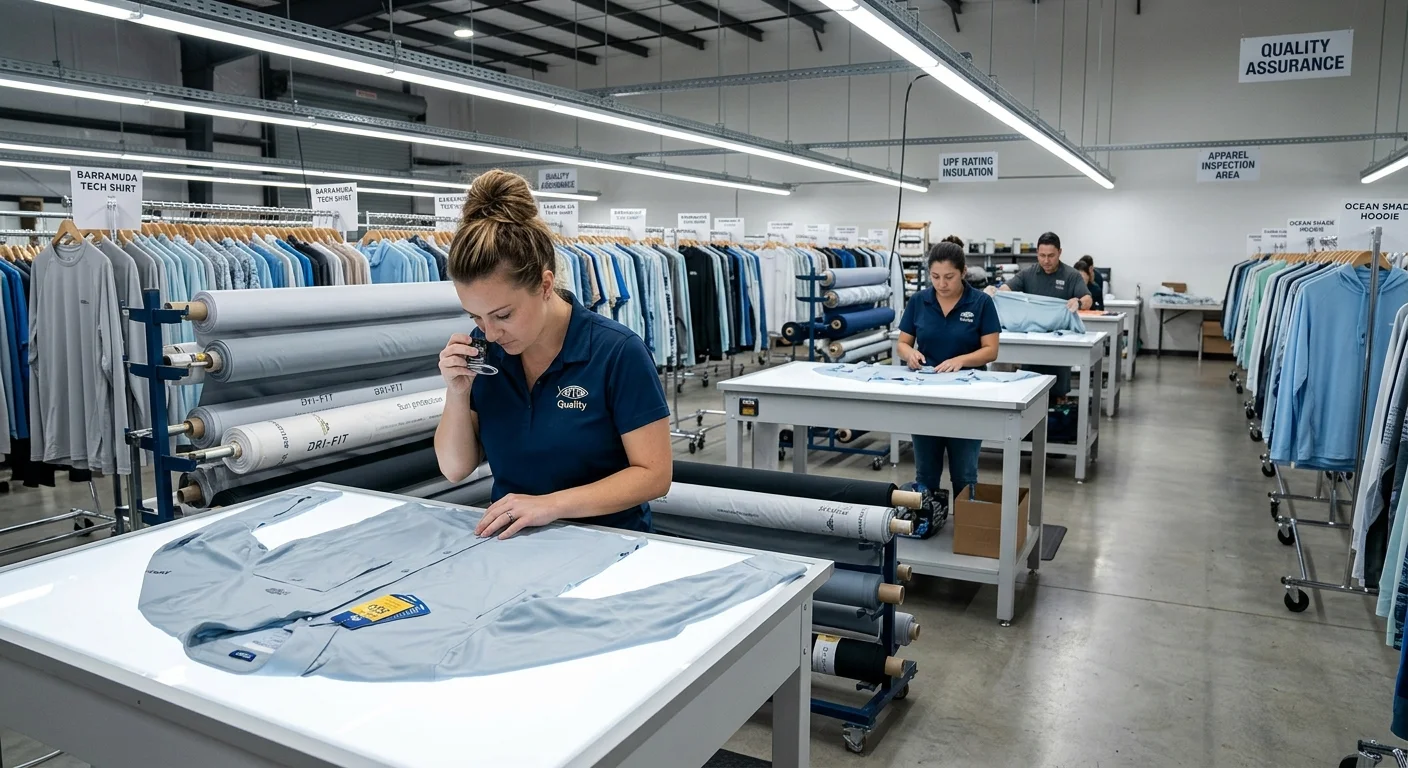
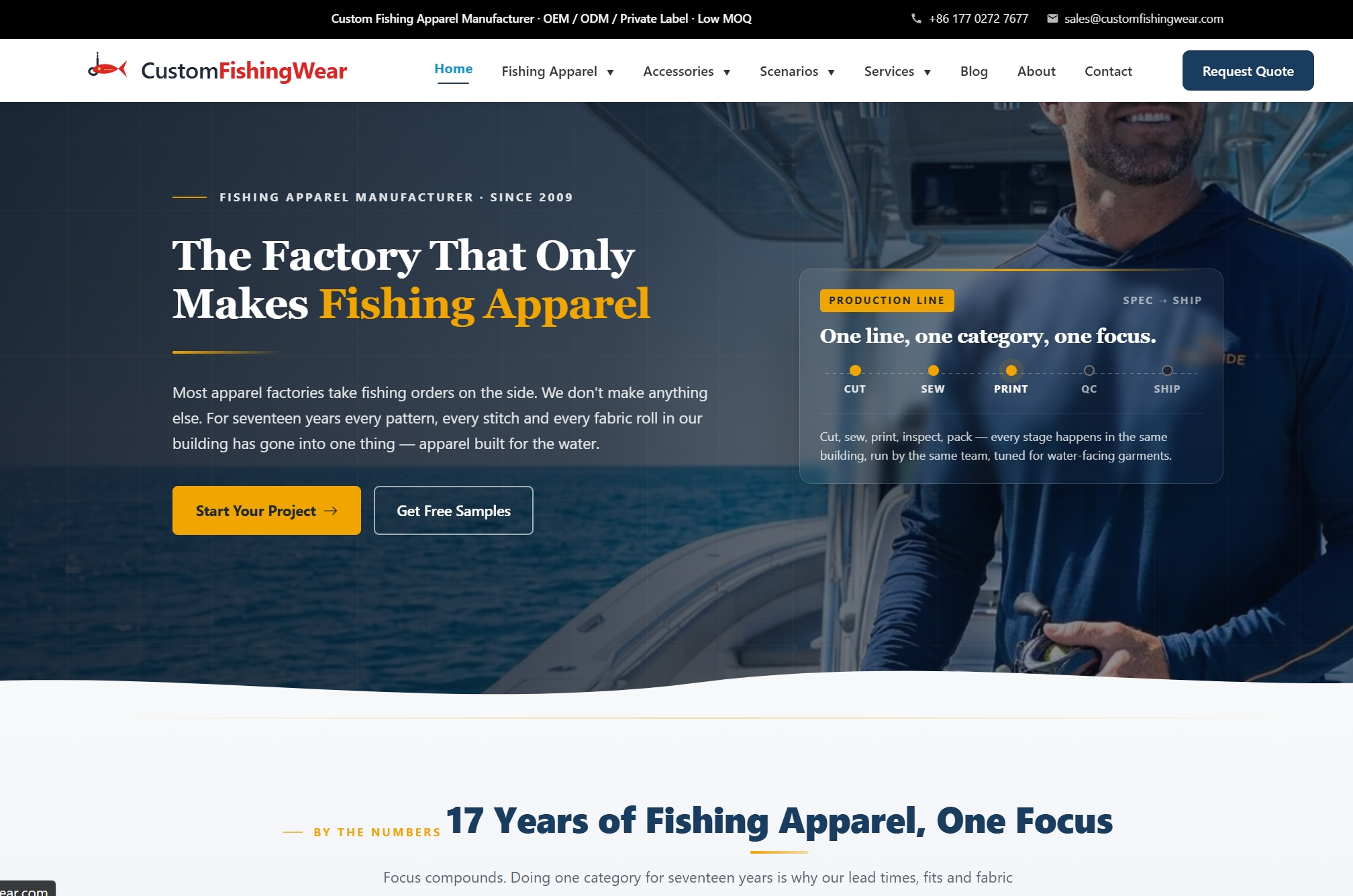
There's a factory out there that does one thing: fishing apparel. Not athletic wear. Not corporate uniforms with a fishing logo slapped on. Just fishing clothing, built from the ground up for people who use it on the water.
That's the premise behind CustomFishingWear.com — a dedicated fishing apparel manufacturer with the tagline "The Factory That Only Makes Fishing Appare Factory." For brands, clubs, or tournament organizers sourcing performance saltwater gear at scale, that singular focus matters more than it sounds.
What "Fishing Apparel Only" Means for Quality
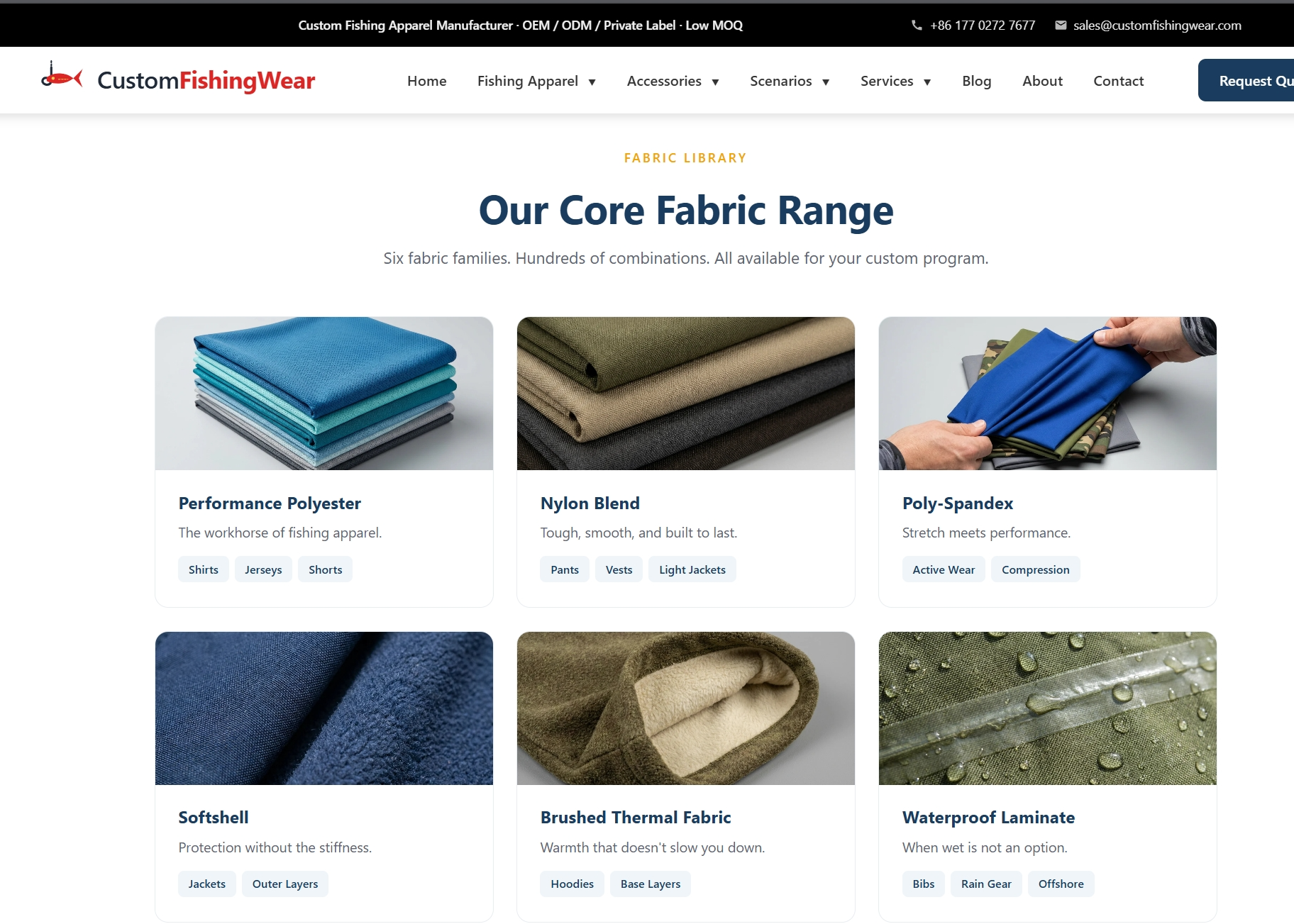
A general sportswear factory treats fishing shirts as one SKU among thousands. A fishing-only production line runs to a different standard. Construction specs — flatlock stitching, UV-blocking fabric selection, moisture-wicking treatments, four-way stretch testing — aren't add-on features. They're the baseline.
The saltwater fishing apparel factory uses a project-mapped production model . Each client order gets its own dedicated line slot. That prevents cross-batch contamination and keeps quality checks meaningful. Inspection runs at every stage — cutting, sewing, printing — not just at the end after problems have already set in.
The OEM/ODM Workflow
The process runs end-to-end:
Brief stage — share a concept, tech pack, or reference garment; the team scopes fabric, fit, and cost
Design & tech pack — production-ready specs and mockups ready for your sign-off
Sampling — prototypes confirmed before any bulk commitment
Production — full cut, sew, and print with staged quality checks throughout
Logistics — DDP or DDU shipping with customs handled straight to your door
That last point is a big deal for international buyers. DDP lets you quote a landed cost into your destination market. You don't have to manage freight logistics yourself.
Before You Commit: Due Diligence Checklist
The site's positioning is strong. Smart sourcing still means verifying before ordering. Reach out and request:
Certification documentation : ISO 9001, OEKO-TEX Standard 100, and UPF 50+ lab test reports — these are what make saltwater fishing apparel hold up in real conditions
MOQ tiers : industry benchmarks for this factory type run 50–100 pcs per design for trial or private-label runs, 300+ pcs for standard bulk production
Lead time confirmation : comparable factories in this niche hit ≤7-day sample turnaround for standard sublimated fishing shirts — confirm they match that
Production tech specifics : sublimation vs. screen vs. digital printing, flatlock vs. coverstitch construction, fabric gsm ranges used for offshore performance tops
A factory this focused should answer every one of those questions without pause. Vague answers tell you something too.
Moisture-Wicking Fabric Standards and Rapid Evaporation Metrics
Sweat isn't the problem. Sweat that stays is.
After two hours of casting in open water, a cotton shirt stops being clothing and starts being a liability. It retains moisture against your skin. It chills you when the wind picks up. It chafes at the shoulders through every cast. Add sea spray to the mix, and that soaked fabric isn't just uncomfortable — it's pulling your core temperature down.
The fix isn't "moisture-wicking fabric" as a broad idea. That phrase appears on the hang tag of half the activewear in any sporting goods store. You need to understand what the numbers behind that claim mean. More specifically, you need to know what threshold separates a shirt that performs on the water from one that just looks the part.
The Metrics That Matter
There are five lab standards worth knowing. They're not obscure. Any solid manufacturer of quick-dry fishing apparel can pull test reports against them. No test reports? The "moisture-wicking" claim is marketing, not engineering.
AATCC TM195 — Liquid Moisture Management (MMT)
This is the core test. It measures how fast liquid absorbs on the inner (skin) face. It also tracks how fast moisture spreads outward. The key number is the One-Way Transport Index (OMMC) . That tells you whether sweat moves away from your skin or just spreads through the fabric in both directions.
Minimum for fishing: OMMC ≥ 300
Target for offshore or high-exertion conditions: OMMC ≥ 400
AATCC TM197 — Vertical Wicking Rate
How high does moisture travel up the fabric in a set time? For engineered synthetic knits, the benchmark is ≥ 100 mm at 10 minutes . Aim for ≥ 60–70 mm at 5 minutes if you're fishing hard in direct sun.
Cotton clocks 3–5 cm in 5 minutes . High-performance polyester knits hit 10–12 cm in the same window. That gap is the difference between a shirt that moves moisture and one that holds it.
AATCC TM199 / TM200 — Drying Time and Drying Rate
These two tests look at the same problem from different angles. TM199 tracks the time to reach 50% moisture loss. TM200 measures the overall evaporation rate.
Minimum standard: ≤ 30 minutes to 50% moisture loss at 25°C
Real-world target on a hot, breezy deck: ≥ 80% moisture loss within 15–20 minutes
A shirt that takes 60 minutes to dry in room conditions will feel clammy for the whole tide change. That's not just a comfort issue. Add sea spray, wind, and repetitive arm motion, and you've got a chafing and heat regulation problem.
ASTM D737 / ISO 9237 — Air Permeability
Evaporation needs airflow. A fabric with strong wicking but poor air permeability is a closed system — moisture moves through the knit but has nowhere to go. The numbers:
Base minimum for breathable fishing wear : ≥ 100 L/m²/s (ASTM D737)
Ventilation panels and mesh zones: ≥ 300 mm/s (ISO 9237)
What Failure Looks Like in the Field
The data makes this concrete. After 30 minutes of moderate effort, a poor-performing fabric holds more than 15 grams of moisture per 100 grams of fabric weight . A well-built synthetic holds less than 5 g/100 g under the same conditions.
That three-to-one gap in retained moisture becomes a real issue the moment a wind gust hits. High retained moisture plus air permeability below 100 L/m²/s speeds up evaporative cooling. Your body works harder to hold temperature. You lose focus on the bite window.
Fiber Composition and What to Avoid
Fabric behavior starts at the fiber level. For moisture-wicking fishing clothing , the reliable starting point is:
≥ 90% polyester / ≤ 10% spandex — polyester builds the capillary channels that push liquid outward; spandex keeps the stretch without blocking airflow
Skip fabrics with > 15% spandex unless the knit structure is built open — high elastane compresses the structure and kills breathability
Heavy DWR or PU coatings on base layers are a trap — they boost water repellency on the surface but drop moisture vapor transmission rate (MVTR) below ~1,000 g/m²/24h, leaving you with a clammy, vapor-locked feel under a shell jacket
Go with hydrophilic polymer finishes or engineered micro-channel yarns instead. These pull liquid through the knit rather than push it back at the surface.
The Field Drop Test
You don't need a lab for a quick check. Place a single water drop on the inner surface of the fabric:
Absorbs and spreads in < 2 seconds — strong capillary action, real wicking structure
Sits on the surface for > 5 seconds — weak wicking, probably a DWR-treated or cotton-heavy blend
For moisture-wicking fishing clothing going onto saltwater, check wash durability too. Quality fabrics publish wicking and drying data after 20–50 wash cycles , with no more than 15% drop in performance. A brand that can't show wash-cycle retention data? That finish will break down faster than the fabric wears out.
The Sourcing Checklist for This Feature
Evaluating a quick-dry fishing apparel claim? Ask the quick-dry fishing apparel supplier or pull the spec sheet and look for these numbers:
Standard | Minimum Threshold | Target (Offshore / High Exertion) |
|---|---|---|
AATCC TM195 (OMMC) | ≥ 300 | ≥ 400 |
AATCC TM197 (Wicking) | ≥ 100 mm / 10 min | ≥ 60–70 mm / 5 min |
AATCC TM199/200 (Dry Time) | ≤ 30 min to 50% loss | ≥ 80% loss in 15–20 min |
ASTM D737 (Air Permeability) | ≥ 100 L/m²/s | — |
ISO 9237 (Vent Panels) | ≥ 150 mm/s | ≥ 300 mm/s |
MVTR (ISO 11092) | ≥ 1,000 g/m²/24 h | Higher for base layers under shells |
Gravimetric Retention | < 5 g/100 g after 30 min | — |
"Moisture-wicking" without a test standard behind it is a design intention, not a performance guarantee. On the water, that difference matters every hour of every session.
Salt Corrosion Resistance and Critical Stitching Weak Points
Saltwater doesn't destroy fishing apparel at a uniform rate. It finds the weak points first — and those weak points are almost always the seams.
Most anglers never think to check this. They evaluate fabric. They check the UPF rating. They tug on the stretch. Then they skip the stitching, buy the shirt, and wonder why the shoulder seam starts fraying after three offshore trips. The fabric is fine. The thread gave out. Thread failure in a saltwater environment isn't a slow process — it's fast, it's predictable, and you can avoid it if you know where to look.
Why Salt Attacks Stitching Before It Attacks Fabric
Consider what happens to uncoated carbon steel in a salt-spray environment. Under ASTM B117 testing — 5% sodium chloride solution, continuous fog, 95°F — uncoated carbon steel shows visible red rust and thread degradation within 2 to 8 hours . Severe structural damage sets in by 24 hours. Marine-grade stainless fasteners, by contrast, hold for 500 to 2,000+ hours under the same conditions.
That gap isn't just a fastener problem. It's a direct parallel for what happens inside your seams.
Salt crystals don't sit on the surface of a garment. They pack into stitch penetrations — the tiny needle holes punched through the fabric during manufacturing. Each wet-dry cycle pushes chloride deeper into those holes, into the gaps between threads, into the tight folds of a seam. Low-grade cotton or surface-dyed polyester thread breaks down under this process in much the same timeframe as uncoated steel. A handful of immersion-drying cycles and tensile strength is already compromised.
The benchmark to look for: thread and seam samples that retain ≥85% tensile strength after ≥240 hours of ASTM B117 salt-spray exposure . That puts the stitching in the same performance range as mid-grade zinc-nickel coatings on marine hardware — not the 2–8 hour failure zone of unprotected materials.
The Four Seam Zones That Fail First
Not all seams fail at the same rate. Salt, flex, and load concentrate at specific locations. Know these four zones and you'll know where to look before you buy.
Shoulder seams. Every time you fight a fish against a rod harness or adjust a lifejacket strap, the shoulder yoke takes combined bending and load. Salt crystals form inside the seam fold during drying. Repeated flex across that crystal bed acts like sandpaper on thread. A seam that opens mid-session isn't bad luck — it's a failure that started at purchase.
Underarm seams. Constant twisting while casting, combined with salt-saturated sweat and spray, pushes chloride straight into stitch penetrations at the armhole. Surface-dyed synthetics at this location are at high risk — they lose strength fast and show the damage as seam puckering and color fade before the thread breaks.
Cuff, collar, and pocket hem stitch lines. Edges are salt crystal collection zones. Crystals pack into the hem's needle holes and work outward. The top stitch breaks first. Once that thread goes, the fabric frays away from the body panel — and it speeds up fast, because anglers regularly grab cuffs and pocket openings under load.
Bar-tacks at tool attachment points. Plier pockets, D-ring mounts, belt loops. These points take concentrated, repeated load. A bar-tack made with low-grade thread becomes the first failure point when you're pulling heavy tackle. This is where a garment that looks solid in the store shows its true construction quality after three months on the water.
The Thread Spec That Separates Durable from Disposable
One specification cuts through most of the confusion: 100% polyester core-spun sewing thread on all structural seams and bar-tacks.
Core-spun construction means a continuous filament polyester core wrapped with a spun polyester sheath. The core carries the load. The sheath handles abrasion. Together, they resist chloride breakdown and hold strength through flex cycles in seam folds — the exact conditions that destroy cotton or rayon thread fast.
This isn't a premium upgrade. It's a baseline requirement for any garment going into a saltwater environment with regular use.
Seam Architecture: What the Construction Should Look Like
Thread type is half the equation. Seam architecture is the other half.
Flatlock seams on shoulder and underarm panels. Multiple thread paths, low profile, broad load distribution. The flat construction leaves fewer raised ridges where salt crystals can collect and cut thread.
4-needle coverstitch seams on hems — cuffs, collars, pocket openings. Four parallel needles with top and bottom looper threads. The extra thread paths mean that if one path degrades, the seam holds. For high-flex torso panels, this construction is the standard to look for.
Doubled bar-tacks at every hardware attachment point. Two stacked tacks, same 100% polyester core-spun thread, at every pocket corner, D-ring, and belt loop. This follows the same logic marine engineers use at high-risk fastener locations — known failure zones get proven-grade materials.
One note on stitch density: 10 to 12 SPI (stitches per inch) on load-bearing seams is the right range. Go lower and each stitch carries too much stress. Go higher and the concentration of needle holes creates a perforation line — a path for salt crystal buildup and faster moisture wicking that works against the construction quality you're paying for.
The Fabric Dye Question Nobody Asks at the Register
Solution-dyed synthetic fabric isn't just a color consistency issue. It's a structural one.
With solution-dyed polyester or nylon, the pigment bonds inside the fiber during manufacturing — not applied as a surface coating after the fact. Salt crystals abrade the fabric surface during repeated rinsing cycles. There's no surface dye layer to strip. The color and the fiber are the same material.
Piece-dyed synthetics — the default for most non-technical sportswear — lose color at the shoulder and upper back first. Those are the highest UV and salt exposure zones. Faded, brittle yarns in those zones aren't just an aesthetic problem. They signal that the fiber structure has broken down alongside the dye.
The colorfastness threshold worth specifying: Grade ≥4 per AATCC 16 or ISO 105-B02 after seawater and UV cycling . Grade 4 means minimal color change under real-world marine conditions. Ask for documentation. A Saltwater Fishing Apparel manufacturer who can't provide it is saying "we don't know" — whether they use those words or not.
The Purchase Checklist for This Feature
Take this into the store or open it alongside any product spec sheet:
Check | What to Confirm |
|---|---|
Thread type | Spec sheet states "100% polyester core-spun sewing thread" on structural seams |
Shoulder/underarm seams | Flatlock or 4-needle coverstitch — not single-needle lockstitch alone |
Hem construction | Coverstitch with bar-tacks at all stress concentration points |
Bar-tack locations | Pocket corners, D-rings, belt loops — doubled tacks on hardware attachment zones |
Salt-spray test data | ≥240 h ASTM B117 with <15% tensile strength loss (ASTM D1683) |
Fabric dye method | Solution-dyed polyester or nylon — reject generic piece-dyed synthetics |
Colorfastness documentation | Grade ≥4 per AATCC 16 or ISO 105-B02 after saltwater/UV cycling |
A brand selling saltwater corrosion resistant fabric as a feature but unable to produce salt-spray test data on seam samples — not just base fabric — has a gap between marketing language and actual engineering proof. The seam is where the garment lives or dies. Verify the seam.
Anti-Odor Microbe Inhibition for Multi-Day Offshore Trips
Three days offshore. Sleeping in a damp cabin. Wearing the same shirt through tide cycles, fish slime, and salt spray. Your clothes don't just smell. They colonize.
This is where most apparel brands get anti-odor fishing gear wrong. They treat odor as a smell problem. It isn't. It's a biology problem. Synthetic fibers — polyester, nylon — have water-repelling surfaces. These surfaces trap body oils, sweat fats, and bacterial films. Regular washing can't break that down. Once bacterial buildup takes hold in the underarms, collar, and waistband, standard detergent cycles stop working. The odor becomes part of the fabric. Anglers call it "perma-odor." Scientists call it a colonized surface. Either way, the result is the same: you toss the shirt before the fabric is even worn out.
Biocidal vs. Odor Masking — The Distinction That Matters
Not all odor-control claims use the same technology.
Biocidal antimicrobial finishes — silver ions, polygiene-type treatments — attack and kill odor-causing bacteria at the source. Test labs confirm performance using AATCC 100 or ISO 20743 protocols. These measure real bacterial reduction in log values. The benchmark for multi-day offshore fishing clothing : ≥99.9% bacterial reduction (3-log) against Staphylococcus aureus and Klebsiella pneumoniae , holding up through ≥50 wash cycles .
Non-biocidal odor control — "freshness finishes," odor-capture systems, fragrance technology — absorbs or covers odor molecules. Labs test these under ISO 17299 or AATCC TM216 . Those protocols measure odor reduction rate, not bacterial kill. In a wet, salty marine environment, microbial load keeps building between washes. These products can't keep up.
A spec sheet that lists ISO 17299 as the only standard? That brand is selling you deodorant chemistry, not bacterial suppression.
What "Permanent" Actually Means on the Label
The word "permanent" in antimicrobial apparel carries a specific technical meaning. Permanent treatments fall into two types. The first: integrated into the fiber during polymer spinning (dope-addition). The second: bonded directly to the textile surface during finishing through a chemical bond. Either way, the treatment becomes part of the fiber structure. There's no surface coating to wash away, so it doesn't wash out.
Topical sprays, laundry additives, and post-use odor treatments work the opposite way. They sit on the surface. Every wash cycle strips a little more away. Fine for a gym bag. Useless after night two in a boat cabin.
Look for these phrases on spec sheets:
- "Built into the fiber"
- "Integrated during spinning"
- "Bonded antimicrobial finish" or "covalently bonded antimicrobial finish"
Reject anything described as:
- "Spray-on," "laundry additive," "topical wash," or "fragrance technology"
The Purchase Checklist for This Feature
Check | What to Confirm |
|---|---|
Test standard | AATCC 100 or ISO 20743 — not ISO 17299 alone |
Efficacy threshold | ≥99.9% bacterial reduction (3-log) documented |
Wash durability | Efficacy retained after ≥50 home launderings |
Treatment type | Fiber-integrated or bonded to fiber — not topical |
Care label | Cold/cool wash compatible; no mandatory hot cycle |
One more thing worth knowing. Your offshore shirts have already picked up that deep marine mildew smell? Standard washing won't fix it. Pre-treat the high-odor zones with an N-acetyl cysteine plus enzyme solution (protease, amylase, lipase) before machine washing. This breaks down the bacterial buildup on synthetic fibers. Think of it as a rescue treatment — not a reason to skip buying gear with real antimicrobial engineering built in from the start.
Articulated Stretch Construction and Casting Mobility Requirements
A shirt can have perfect UPF ratings and lab-certified antimicrobial treatment — and still wreck your cast. The problem is almost always construction. Or rather, the lack of it.
Saltwater fishing demands a full, unloaded overhead cast. That motion pulls the entire back panel tight, loads the shoulder seam, and pushes your arm past the range most athletic wear was built for. A shirt cut on a standard straight pattern fights you at that point. You feel it as tightness across the upper back, a shoulder seam that creeps forward, or a clipped follow-through that slowly kills your accuracy across a full tide.
Why Pattern Engineering Beats Stretch Fabric Alone
Most people reach for a stretchy fabric as the fix. That helps, but only partly. A fabric with 2–5% elastane blended into the polyester knit adds real flex without losing its shape. Go past 5% spandex content and you start trading durability for stretch — and that trade-off breaks down fast under saltwater and regular wash cycles.
Even so, a stretchy fabric cut in a bad shape is still a bad shirt. The pattern geometry matters more than the fabric.
What to look for in the construction:
Bias-cut or yoked back panels — diagonal or shaped seams across the upper back spread the load during a cast. This keeps stress from piling up at one seam line
Raglan or set-in sleeve articulation — the armhole shape decides how far the sleeve can move before it starts pulling the chest panel along with it
Multi-panel back construction — separate shaped panels can each flex on their own. A single flat back piece, even in a stretchy fabric, can't match that
The Lower-Body Mobility Package
Fishing pants and waders follow the same logic, just with different weak points. The crotch and knees are where stiff construction fails first — on a boat deck, climbing over rocks, or dropping into a low crouch to land a fish.
The mobility features worth checking for:
Gusseted crotch — a diamond or box gusset removes the pull across the seat during a wide stride or deep crouch. Without it, that fabric tension goes straight to the inseam. That's one of the first seams to fail when salt has weakened the thread
Articulated knees — pre-shaped knee panels built with a slight forward bend stop the fabric from bunching behind the joint and pulling the hem up as you kneel. A flat-cut knee works against your leg's natural position
Reinforced seat and knee panels — for rock fishing or rough deck surfaces, 200D–500D nylon reinforcement at high-wear zones is a structural decision, not just a durability bonus
The In-Store Movement Test
Don't buy fishing pants without running this sequence: deep squat, high step, kneel . The waistband pulls down at the back? The inseam binds? Fabric drags tight across the knees? The pattern wasn't built for this kind of work. The fabric might be great. The shape is wrong.
The same test applies to shirts. Do a full overhead casting motion in the store. The back panel rides up? Shoulders pull forward? You feel resistance at the top of your reach? That's the seam and cut giving you information the hang tag never will.
Quick-reference construction checklist:
Feature | Minimum Specification |
|---|---|
Elastane content | 2–5% (4-way stretch) |
Back construction | Bias-cut yoke or multi-panel articulated back |
Sleeve geometry | Raglan or articulated set-in with full overhead range |
Crotch construction | Diamond or box gusset |
Knee construction | Pre-shaped articulated panels |
Reinforcement zones | 200D–500D nylon at seat and knees |
Movement test | Squat, high step, kneel — no binding or waist pull |
Stretch fabric gets the credit. Pattern engineering does the work. Check both before you commit.
Conclusion
Every season, anglers waste money on gear that looks good but falls apart fast. Salt air and sun are brutal. A shirt that survives one offshore trip is not the same as one that earns a permanent spot in your bag. Six measurable standards separate them — not marketing buzzwords on a hangtag.
You now have the framework. Here's what the baseline looks like:
UPF 50+ rated UV protection fishing apparel
Reinforced stitching that holds up against salt crystals
Moisture-wicking fabric that pulls sweat away from your skin — not traps it
Ventilation built for real casting motion
These aren't premium upgrades. They're the minimum you should expect.
So before you click "add to cart" or grab something off the rack, run it against the checklist. Ask hard questions. A brand that can't tell you the UPF rating or how their seams are treated? That silence tells you everything.
Buy once. Buy right. The ocean doesn't forgive cheap gear — and neither should you.