Pick up any fishing jacket and flip the tag. You'll see "2-layer," "2.5-layer," or "3-layer" printed there — with zero explanation of what any of it means for your day on the water. That gap between the spec sheet and real-world performance is exactly where most buyers make expensive mistakes.
Sourcing a waterproof breathable membrane jacket for a private label fishing jacket brand? Outfitting a tournament team? Or just trying to stay dry through a six-hour downpour on the coast? The layer count is not a marketing number. It's a core engineering decision. It shapes weight, packability, breathability, and how long the jacket holds up after a hundred washes.
This guide cuts through the technical noise. It maps each construction type to the conditions, budgets, and use cases where it earns its place.
What "Layers" Mean in Fishing Jacket Fabric Construction
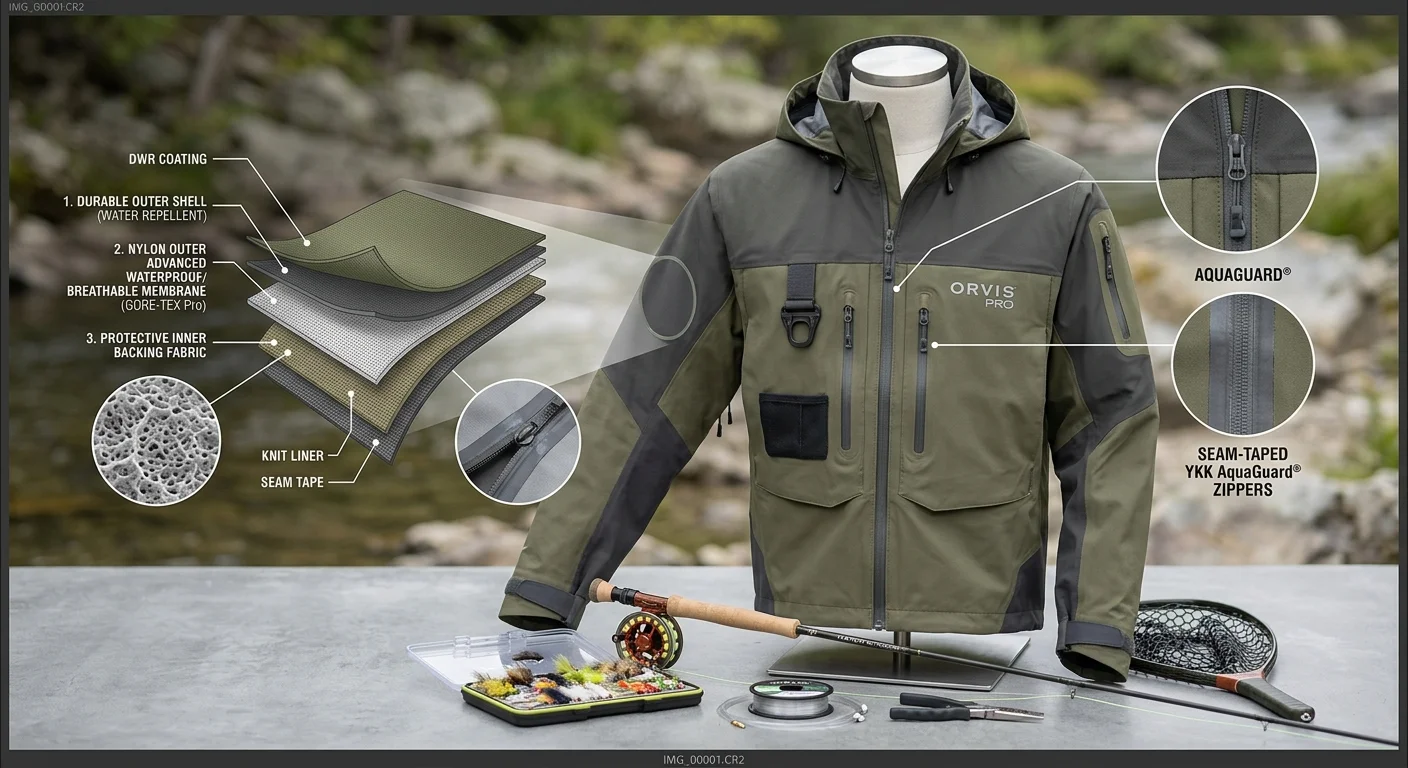
That number on the tag isn't counting sheets of fabric. It describes a bonding architecture — how the inner lining connects to the waterproof-breathable membrane at the jacket's core.
Every serious waterproof fishing jacket is built around the same three structural elements:
Face fabric — the outer woven shell (nylon or polyester, 20D to 70D). Higher denier means more abrasion resistance. It also means more weight.
Waterproof-breathable membrane — sits beneath the face fabric. ePTFE membranes use microscopic pores. The pores are small enough to block liquid water droplets, yet large enough to let water vapor escape outward.
Inner liner — shields the membrane from body oils, salt, sweat, and friction. Its form — a full bonded tricot, a printed half-layer, or a hanging mesh — is what defines the "layer" count.
One more element worth knowing: DWR coating . It sits on the face fabric surface and makes rain bead up and roll off. Here's the key point — DWR failure doesn't mean the membrane has failed. A worn-out DWR coating lets the outer fabric soak through and feel cold. That kills the wearing experience, even when the membrane still passes a 20,000mm hydrostatic head test.
Understanding this construction also helps buyers evaluate a professional waterproof fishing jacket manufacturer.So "2-layer," "2.5-layer," and "3-layer" describe a lamination logic , not a physical count. More layers don't mean better performance. Each adds a different structural tradeoff — in weight, durability, breathability, and cost.
2-Layer Fishing Jacket Fabric: Structure, Performance & Best Use Cases
The 2-layer construction is the most common fishing jacket fabric on the market — and also the most misunderstood.
Here's what's inside: a face fabric ( 70–200D nylon or polyester with a DWR coating) laminated to a waterproof-breathable membrane on its inner side. That membrane — PU or ePTFE — delivers a hydrostatic head of 8,000–15,000mm . That's solid coverage for rain, spray, and sitting on a wet boat seat. So far, so good.
The defining feature is what comes next: a separate hanging liner . This is not bonded to the membrane. It's stitched at the hood, hem, cuffs, and zipper tape — and free-floating everywhere else. That loose construction creates an open cavity between the liner and the membrane.
Why the Hanging Liner Exists (And What It Costs You)
The liner serves two real purposes. First, it shields the membrane from body oils, sweat, and sunscreen. Those contaminants clog micropores and break down waterproofing over time. Second, it blocks that cold, plastic-like membrane feel against your forearm after six hours on the water.
Common liner materials include polyester mesh (40–80 g/m²) for airflow, or smooth taffeta/satin nylon (60–120 g/m²) for a better slip-on feel over base layers. Both work. Neither is free.
The tradeoff is weight and bulk. A finished 2-layer fishing jacket runs 550–900g — heavier than a comparable 2.5-layer or 3-layer shell at 350–550g. The combined fabric system stacks to 130–270 g/m² , versus 100–180 g/m² for laminated alternatives.
That floating cavity is also where moisture lingers. Humid air builds up between the liner and membrane — especially if you're standing still on a pier with your hood up. The membrane is still doing its job. But the jacket feels damp and cool from the inside. Four hours into a light-rain session, that difference is the reason you start to shiver.
Performance Snapshot
Metric | 2-Layer Rating | Notes |
|---|---|---|
Weight | ❌ Heaviest | 550–900g finished jacket |
Breathability | ⚠️ Medium | MVTR 10,000–15,000 g/m²/24h; reduced by liner cavity |
Waterproofing | ✅ Adequate | 8,000–15,000mm hydrostatic head |
Abrasion resistance | ⚠️ Medium | Good on inner surfaces; face fabric varies by denier |
Hand feel | ✅ Soft & drapey | Most comfortable against skin |
Price | ✅ Most affordable | Retail from US$70–180 |
Where 2-Layer Works Best
This construction fits specific, well-defined conditions:
Nearshore and inshore recreational fishing — piers, jetties, small lake boats, reservoirs — with rain exposure of 1–3 hours of light to moderate precipitation
Short day trips where shelter or the car is close by and you're not committing to a full-day storm
Budget-sensitive buyers who need solid waterproofing without the price tag of guide-grade gear
The soft, drapey hand feel earns its keep here. Casting from a seated position for hours straight, you want a jacket that moves with you — not one that crinkles and stiffens. That matters more than most people expect.
Where It Starts to Fall Short
Push a 2-layer jacket into sustained heavy rain and the gaps show fast. DWR wet-out hits after 30–60 minutes of steady rain without reproofing. The face fabric saturates and gains water weight. The liner traps the humidity that builds up. What felt fine at hour one turns cold and clammy by hour three.
For all-day offshore trolling, steelhead guiding in continuous downpours, or any setup requiring minimal bulk under wader suspenders or a PFD — the hanging liner becomes a liability, not an asset.
Go with 2-layer : rain is intermittent, total wet exposure stays under 3–4 hours, activity output is low, and price-to-performance ratio is your top priority.
Step up to 2.5-layer or 3-layer : the forecast says all day, the terrain demands fast movement, or your gear setup leaves no room for extra bulk.
2.5-Layer Fishing Jacket Fabric: The Lightweight Sweet Spot Explained
Drop the hanging liner. That's the 2.5-layer approach — and it's why this construction owns the lightweight rain shell market.
The build is simple. You get a 40D–75D nylon or polyester face fabric with DWR coating, bonded to a PU or ePTFE waterproof-breathable membrane. On the membrane's inner face sits a printed or sprayed micro-pattern . That printed layer — dots, grids, or honeycomb — is the "0.5." It's not a full fabric. It's a polymer coating. Thick enough to shield the membrane from sweat and body oils. Thin enough to keep the weight low.
No full liner means 15–30 g/m² less fabric weight. On a finished M-size jacket, that cuts 60–120g compared to a 2-layer build. You also get a jacket that compresses to 0.5–1.0 liters packed. Fist-sized. This is the jacket that stays in your fishing pack, ready for an unexpected afternoon squall.
Where the Numbers Land
Waterproofing starts at 10,000–20,000mm hydrostatic head — enough for sustained heavy rain. Breathability hits MVTR 10,000–20,000 g/m²/24h , with RET values in the 6–13 range . Solid performance. Not class-leading.
Retail pricing runs US$80–250 . That puts it squarely between 2-layer entry-level builds and 3-layer technical shells at $200–500+.
The Real Tradeoffs
The printed inner layer wears in a predictable spot. Shoulder zones take the most abuse — pack straps grind the coating down first. After 3–5 seasons of heavy use , expect waterproofing to fade at the upper back and shoulders.
Breathability also struggles during active movement. Go wade-fishing or hike into a spot for 1–2 hours , and the printed coating traps just enough vapor to feel clammy. The fix is straightforward: pair it with a 120–180 g/m² moisture-wicking base layer between your skin and the shell. Don't skip that layer.
2.5-layer earns its place as a packable backup shell for freshwater bank fishing, fair-weather day trips, and buyers who need real waterproofing without paying guide-grade prices. Take it into multi-day offshore conditions or heavy gear contact, though, and you'll hit its limits fast.
3-Layer Fishing Jacket Fabric: Maximum Durability for Demanding Conditions
Three layers, bonded together. No hanging liner, no printed half-measure — just face fabric, membrane, and a knit tricot backing pressed into one solid shell.
That's the whole structural idea. It changes everything from there.
The outer face fabric runs 70D–150D nylon or polyester , DWR-treated, often with mechanical stretch built in. The waterproof-breathable membrane — ePTFE, PU, or Toray custom film — bonds to it. The inner tricot backing, weighing 30–80 g/m² , hot-press laminates to the membrane's back face. The result: the membrane never touches your gear, your pack straps, or your skin. Both sides stay covered and protected.
Why That Bonding Architecture Matters
The membrane is the most fragile part of any waterproof jacket. Salt, body oils, and friction wear down its micropores over time. In a 2-layer build, the hanging liner covers only part of the membrane's inner face. In a 2.5-layer, the printed coating is the one thing standing between the membrane and your fishing vest.
In a 3-layer build, woven fabric covers both faces of the membrane. That physical barrier takes the shear stress from pack straps — which can go above 0.2–0.3 MPa under wet load — before it ever hits the membrane. The gap in service life is clear: 5–10+ years for a well-maintained 3-layer jacket versus 3–7 years for a similar 2-layer build. That's a 30–50% longer usable lifespan .
Performance Numbers, Laid Out Clearly
Metric | 3-Layer Rating | Specific Range |
|---|---|---|
Waterproofing | ✅ Best-in-class | 10,000–30,000mm hydrostatic head |
Breathability | ✅ High | MVTR 8,000–20,000 g/m²/24h |
Fabric weight | ✅ Efficient | 110–160 g/m² (lighter than 2-layer) |
Abrasion resistance | ✅ Strongest | Dual-side membrane coverage |
DWR durability | ✅ Longest-lasting | Stable after 70+ machine washes (Shimano DRY SHIELD+ data) |
Price | ⚠️ Premium | Retail US$300–700 |
For offshore and saltwater use, premium Toray 3-layer fabrics reach 30,000mm waterproofing. That's the point where wave surge and constant sea spray stop being a problem. Mid-tier 3-layer builds at 15,000mm handle a full day of heavy rain on a boat with no water getting through.
Where 3-Layer Pays for Itself
The price gap is real. A quality 3-layer fishing jacket runs US$150–300 more than a similar 2-layer build. For weekend anglers fishing 10–15 days a year, that cost is hard to justify.
For everyone else, run the actual numbers. A guide or tournament angler fishing 100+ days a year gets 500–1,000+ use days from a 3-layer jacket. That extra $200 spread across five seasons comes out to under $0.40 per outing .
3-layer construction earns its cost in four specific situations:
Offshore and nearshore saltwater fishing — sustained rain, wave spray, salt exposure, constant rail and gunwale contact
Tournament and high-frequency use — 50–150 days on the water per year, repeated friction from chest packs, wader suspenders, and PFDs
Multi-day rain trips — creek fishing or backcountry access where re-waterproofing isn't possible mid-trip
Any setup with extended pack contact — the tricot inner layer takes the mechanical stress that causes shoulder-zone delamination in 2.5-layer shells
Your fishing is casual and rain exposure stays short? 3-layer is more jacket than you need. Conditions are tough and your gear budget needs to go the distance? This is the build made to outlast everything else on the water.
Head-to-Head Comparison: 2-Layer vs. 2.5-Layer vs. 3-Layer Across 6 Key Dimensions
Six dimensions. Three constructions. One table that settles most of the argument before you read another word.
Dimension | 2-Layer | 2.5-Layer | 3-Layer |
|---|---|---|---|
Weight & Packability | Heaviest option. The hanging liner adds bulk. Finished jacket weighs 550–900g. | Lightest of the three. No separate liner. Compresses to a fist-sized 0.5–1.0L. 10–25% lighter than 2-layer. | Middle ground. Heavier than 2.5-layer, but lighter than 2-layer. Fabric weight runs 110–160 g/m². |
Waterproof Durability | Strong waterproofing out of the box. The membrane only has protection on one side — body oils and friction wear it down faster. | Starts close to 3-layer performance. The printed coating wears down over time. After 50 washes: ~70–80% of original waterproofing remains. | Membrane protected on both sides. After 50 washes: ≥90% waterproofing retained . Top seam-sealed fishing jacket choice for heavy, repeated use. |
Breathability | Good airflow early on. The air gap between liner and membrane cuts condensation buildup. That's a real plus in cold, damp conditions. | Rated MVTR 10,000–20,000 g/m²/24h on paper. In real use, the printed coating cuts vapor transmission. Users report a clammy, skin-sticking feel in wet conditions. | The tricot backer lets vapor pass through while protecting the membrane. Long-term breathability beats 2.5-layer — the membrane holds up longer, so performance stays steady over years. |
Abrasion Resistance | Membrane sits exposed on the inner side. Pack straps and wader suspenders create friction hot spots over time. | The printed coating offers minimal protection. High-contact zones — shoulders, chest, rails — wear faster. Coating separation shows up after heavy use. | Dual-side coverage absorbs mechanical stress before it hits the membrane. Delamination resistance is strongest here. This is the go-to laminated fabric fishing gear for guides and tournament teams. |
Wearing Comfort | The mesh or taffeta liner feels soft. Best direct skin contact of the three. Extra weight and slower drying are the trade-offs in active use. | Coating dots and printed patterns feel plastic-like against skin. In rain, paddling, or wading conditions, that surface turns sticky and cold. | The tricot inner fabric feels like a light lining — not bare membrane. More comfortable than 2.5-layer. Slightly softer than 2-layer. Technical cuts give you better range of motion for casting and rigging. |
Price & Lifetime ROI | US$150–400 retail. Lifespan: 3–7 years. Example: $250 over 5 years = ~$50/year . | US$100–200 for membrane builds; under $100 for coating-only versions. Low entry cost, but performance drops off fast after year 3. | US$300–700 retail. Lifespan: 5–10+ years. Example: $450 over 8 years = ~$56/year . Factor in warranty returns and membrane failures — 3-layer ROI beats 2.5-layer across the full product life. |
The Breathability Myth, Corrected
The biggest mistake buyers make: assuming more layers mean worse airflow. That's not how it works.
The 2.5-layer construction lays a solid printed or sprayed coating across the entire inner face of the waterproof breathable membrane. That coating is the breathability bottleneck. It blocks vapor diffusion in a way that a woven tricot backer does not.
The 3-layer tricot backer has open pores. Vapor passes straight through. The membrane stays cleaner too — shielded from salt, sweat, and sunscreen on both sides. So its micropore structure holds up longer. A contaminated membrane loses both waterproofing and breathability at the same time.
What brand and fabric mill testing shows:
3-layer : ≥90% waterproofing retained after 50 wash cycles. Breathability stays flat and steady.
2.5-layer : 70–80% waterproofing after 50 washes. The coating breaks down — and moisture vapor transmission drops with it.
Real-world fishing backs this up. After six-plus hours in heavy rain on a boat or wading a creek, 2.5-layer users report a clammy, condensation-heavy feel inside the jacket. The same conditions in a quality 3-layer seam-sealed fishing jacket feel dry inside with full freedom of movement. The structure delivers that result — it doesn't just claim it on a hangtag.
Matching Fabric Layers to Your Fishing Scenario: A Practical Decision Guide
Layer count isn't about specs on paper. It's about what you're doing, where you are, and how long you're staying out.
Here's a direct scenario-to-layer map:
Casual shore fishing / short sessions → 2-layer. Light rain under 3 hours, low activity, budget matters. This is the right tool for that job.
Freshwater hiking / packable backup shell → 2.5-layer. You're moving fast and sweating. You need something that packs down to fist-size once the sky clears. Mobility and packability come first here. Long-term durability is secondary.
Active wading / mixed-weather all-day sessions → 2.5-layer or entry 3-layer. Conditions keep shifting and you're not heading back to the truck? Step up to an entry 3-layer. That extra protection pays off by hour five.
Offshore, tournament fishing, sustained heavy weather → 3-layer, every time. Salt spray, constant rail contact, wave surge — this is the environment laminated fabric fishing gear was built for.
The 5-Question Decision Check
Not sure where you land? Run through these:
How long are you out? 2–4 hours → 2-layer. Full day or multi-day → 2.5-layer or 3-layer.
What's the forecast? Sunny with light wind → lightweight DWR fishing apparel. Cold, wet, sustained rain → 3-layer.
Do you need to pack it? Yes → 2.5-layer wins on compressibility. No → 3-layer is the better long-term investment.
How hard are you moving? High-output wading or hiking in → focus on moisture-wicking performance from your fishing jacket base layer. Staying stationary? Add mid-layer insulation instead.
What's your budget ceiling? Entry → 2-layer. Mid-range → 2.5-layer. Premium, all-conditions, high-frequency use → 3-layer.
For B2B Buyers: Align Layer Count With Product Line Positioning
Map layer count to product tier — not personal preference. Sourcing decisions get much cleaner that way:
Entry-level SKUs: 2-layer construction. Lead with quick-dry, UPF 50+, and lightweight build. Best fit for recreational shore anglers and summer markets.
Mid-tier SKUs: 2.5-layer. A packable waterproof-breathable membrane shell with strong breathability. This tier reaches the widest customer range and carries the strongest value story.
Flagship SKUs: 3-layer. Full protection, a cut that works well with base layers, built for tournament teams, offshore brands, and cold-weather specialists.
The rule that holds across every sourcing decision: hot, short, light activity → 2-layer. Mobile, variable weather, pack-conscious → 2.5-layer. Cold, wet, long exposure, high-frequency use → 3-layer.
Common Buying Mistakes to Avoid Choosing Fishing Jacket Fabric Layers
Most jacket decisions go wrong before the buyer ever reaches layer count.
Mistake 1: Chasing waterproof ratings while ignoring breathability. A 20,000mm hydrostatic head rating means nothing on a six-hour wade session. You're sweating hard. The jacket traps that vapor. You're soaked from the inside out. For active fishing, waterproofing, breathability, and weight all have to work together. A jacket that scores high on one and fails the others will underperform in the field — and sit on shelves.
Mistake 2: Assuming more layers means more weight. It doesn't. A 3-layer build at 110–160 g/m² runs lighter than most 2-layer systems with hanging liners. Layer count describes how the materials bond together. It has nothing to do with final weight.
Mistake 3: Confusing DWR with actual waterproofing. DWR makes rain bead and roll off the face fabric. That's the whole job. See water spreading dark across the outer shell instead of beading up? DWR is wearing out — not the membrane. The fix is a wash plus a reproofing treatment. You don't need a new jacket. Also, skip fabric softener. It breaks down DWR chemistry fast.
Mistake 4: Putting a 2.5-layer jacket into heavy-rotation, high-friction use. The printed coating wears out first at the shoulders and chest. That's where pack straps and PFDs grind day after day. Guides or tournament anglers fishing 100+ days a year will see a 2.5-layer shell break down much faster than a 3-layer build. The durability gap is real at that volume.
B2B Sourcing Checklist
Lock these specs in before approving any fishing jacket order:
Waterproofing rated 10,000mm minimum
All seams taped — not just critical seams — for true waterproof construction
Waterproof or laminated zippers across the jacket
DWR grade spelled out in the spec, with reproofing support confirmed by the Layer Fishing Jacket supplier
Face fabric in polyester or nylon — cotton has no place in active fishing gear
Layer count chosen based on actual end-use, not marketing positioning
FAQ: Most Asked Questions About Fishing Jacket Fabric Layers
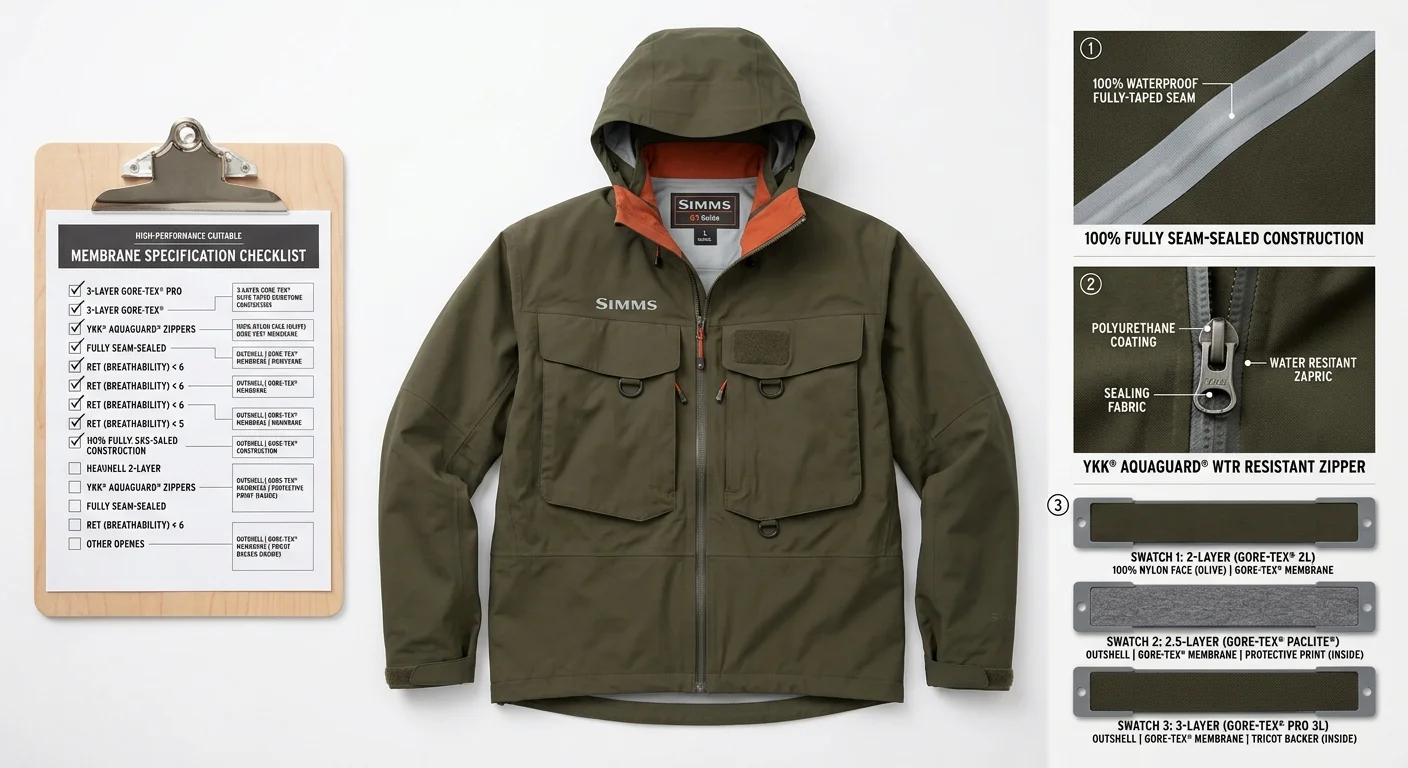
Seven questions come up all the time. Here are straight answers.
Q: Is 3-layer worth the price premium?
Yes — under the right conditions. A 3-layer fishing jacket costs 20–40% more upfront, but lasts 1.5–2× longer under hard use. Fish 60–80+ days a year? The replacement math alone justifies it. B2B buyers sourcing for rental fleets or pro staff: 3-layer is the default pick at that usage volume. The higher unit cost pays for itself before year two.
Q: Can 2.5-layer handle heavy rain?
It depends on the hydrostatic head rating. At ≥15,000mm, yes — sustained rain and boat spray for several hours. Below 5,000mm, don't count on it. For daily guide or charter use, most brands move to 3-layer. It reduces warranty claims and keeps clients dry through long shifts.
Q: Does Gore-Tex matter?
It does. A Gore-Tex fishing jacket hits 20,000–28,000mm waterproofing and 15,000–25,000 g/m²/24h breathability. That's well above most proprietary PU membranes. It also cuts defect and leakage complaints by an estimated 30–50% over a three-year wear period. That's a real sourcing number, not a marketing one.
Q: Do more layers hurt breathability?
No. The membrane controls breathability — not the layer count. A 3-layer tricot backer adds less than 10–15% MVTR loss versus a 2.5-layer shell using the same membrane. The 2.5-layer's printed coating often feels less breathable. It sits against skin and traps vapor. So the extra layer doesn't hurt — the coating placement does.
Q: What ratings should I target?
- Casual shore or bank fishing: 5,000–10,000mm / ≥5,000 g/m²/24h
- Freshwater wading and mixed showers: 10,000–15,000mm / 8,000–15,000 g/m²/24h
- Offshore, saltwater, sustained heavy weather: ≥15,000mm / 10,000–20,000 g/m²/24h, full seam tape
Match the rating to the use case. Over-specifying costs margin. Under-specifying costs customers.
Q: How does layering under the jacket affect performance?
Cotton kills the system — it holds up to 27× its weight in water. Use a synthetic or merino moisture-wicking base layer instead. Add a fleece mid-layer for cold conditions. Let the waterproof breathable membrane shell handle vapor management. Pair a ≥10,000 g/m²/24h MVTR shell with a proper wicking base layer. That combo clears up most "sweating inside" complaints before they reach your returns desk.
Q: How should brands structure their product line by layer count?
One clean approach: a 2.5-layer lightweight packable shell for warm-weather and fair-weather buyers, plus a 3-layer pro shell for guides, tournament teams, and cold/offshore conditions. That pairing covers the full customer range without overlap. Add entry-level 2-layer SKUs as a third tier if budget buyers are part of your target market. Three tiers, clear positioning, no cannibalization.
Need a specific layer configuration — custom fishing jackets waterproofing targets, GSM, membrane type, or seam-tape spec? Visit customfishingwear.com to check fabric tech packs and bulk order options built around your fishing jacket line.
Conclusion
Choosing the right fishing jacket fabric isn't about finding the most technical spec on the market. It's about matching where you fish, how hard you use your gear, and what you're willing to spend.
Casual weekend sessions? A 2-layer construction keeps things light and affordable. Want packability with real weather protection? The 2.5-layer hits that middle ground well. For tough conditions — offshore swells, driving rain, multi-day tournaments — a 3-layer laminated fabric fishing gear setup holds up where others fail.
Here's the bottom line: fabric layers aren't a marketing ladder. They're a practical decision.
Sourcing custom fishing jackets for a brand, a team, or the fishing jacket wholesale line? CustomFishingWear.com helps you spec the right construction from the start — no guesswork, no expensive re-orders.
Pick the layer that matches your water. Everything else follows.