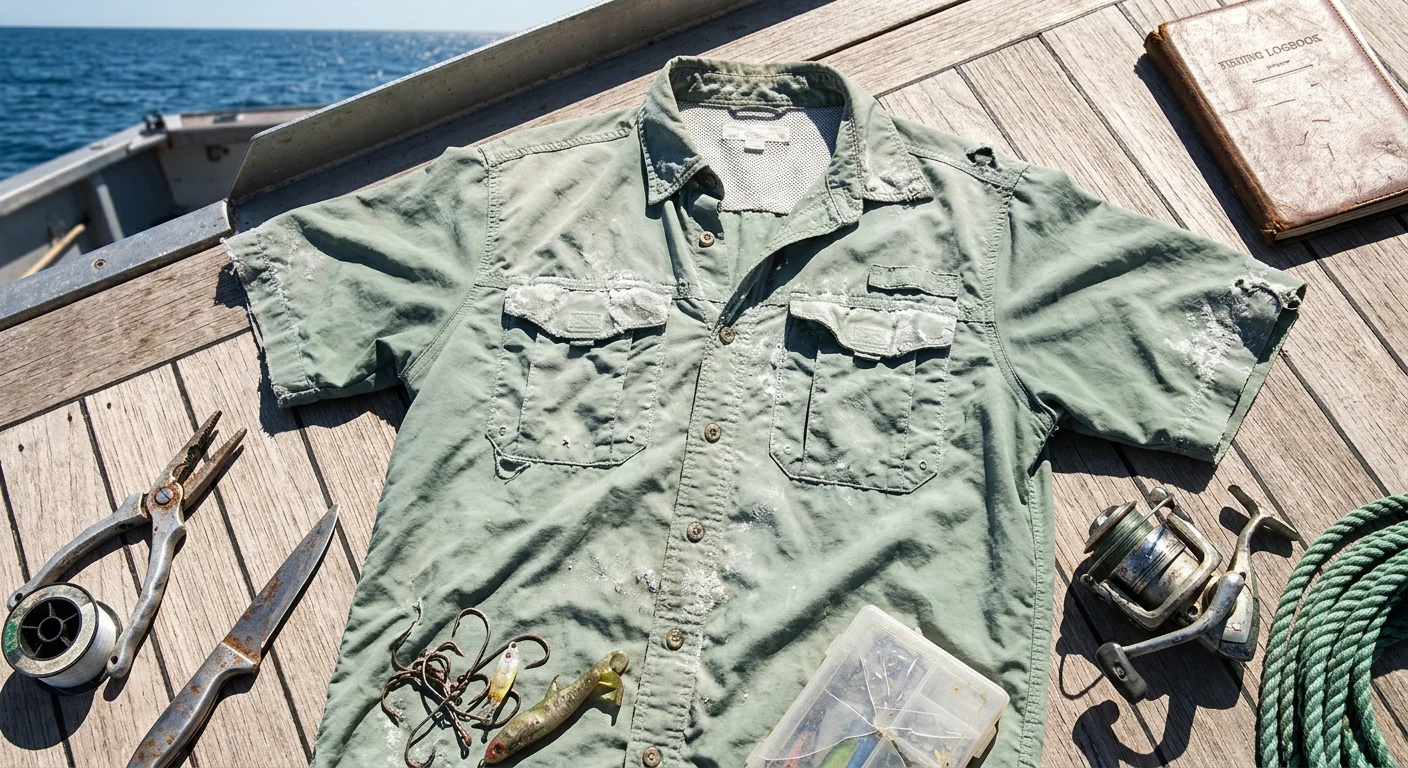
A sublimated fishing jersey that bleeds color after two offshore trips isn't a product problem — it's a sourcing failure.
The difference between a jersey that holds its graphics through saltwater spray, sweat-soaked summer tournaments, and brutal UV exposure versus one that fades into a washed-out ghost? It comes down to three things:
Which colorfastness tests to run
What the passing thresholds mean in practice
How to spot a failing sample before it ships to your customer
This guide covers the three stress environments that destroy sublimated fishing apparel — sunlight, perspiration, and marine immersion. Each one maps directly to the ISO 105 colorfastness standards that apply to it. You'll get the test parameters, grey scale rating benchmarks, and a field-ready QC checklist you can drop straight into a Sublimated Fishing Jerseys supplier contract or factory audit.
Colorfastness Testing Standards Matrix & Minimum Pass Grades
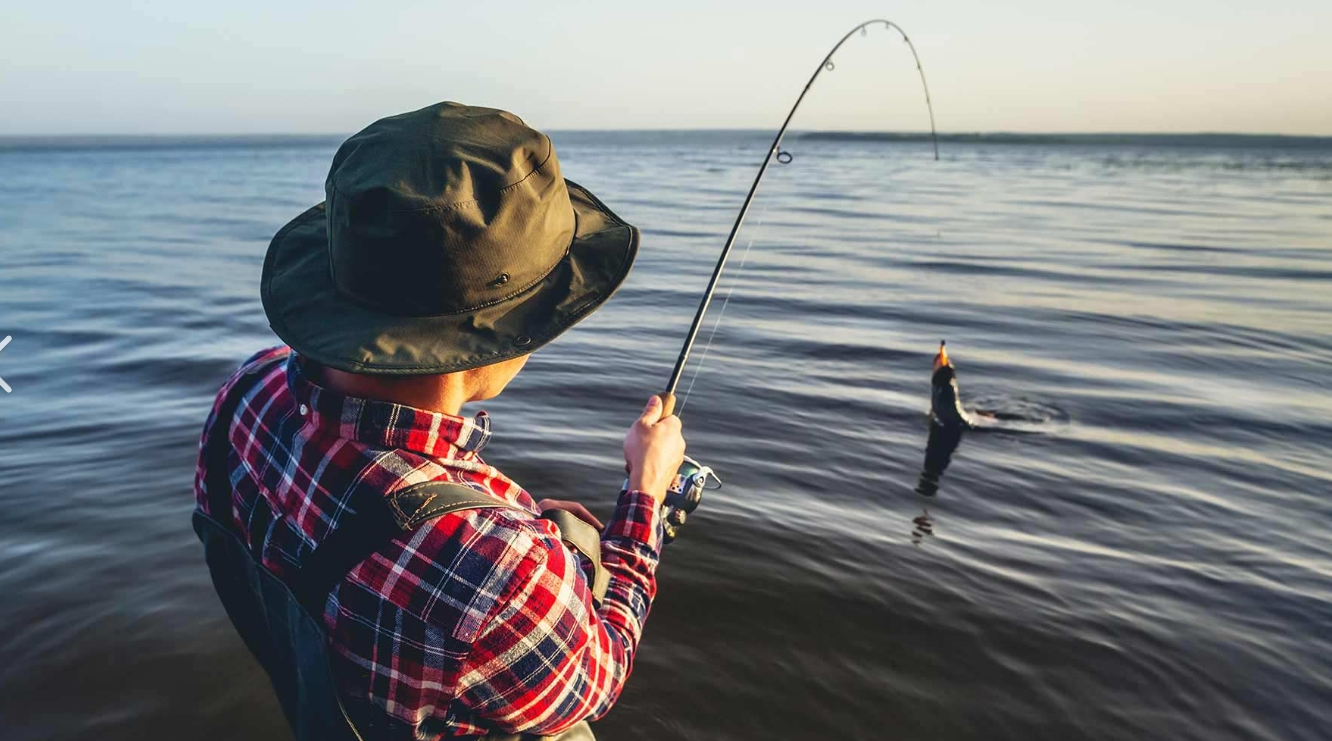
Five tests. Three failure environments. One number that decides whether your jersey holds up through the season — or ends up a faded embarrassment tied to a dock piling.
Below is the full standards matrix, built from ISO 105 and AATCC frameworks. These minimum pass grades belong in every Sublimated Fishing Jerseys wholesaler contract and Sublimated fishing jerseys factory QC checklist.
The Core Testing Matrix
Stress Environment | Standard | Key Test Conditions | Rating Tool | Minimum Pass Grade |
|---|---|---|---|---|
Sunlight / UV | ISO 105-B02 / AATCC 16 | Xenon arc lamp; black panel 42–63°C; ~0.35–0.55 W/m² irradiance | Blue Wool 1–8; Grey Scale | Color change ≥ Grade 4 (Blue Wool 5–6 equivalent) |
Perspiration | ISO 105-E04 / AATCC 15 | Acid sweat pH 5.5; 37°C; 4h under pressure with multifiber adjacent fabric | Grey Scale (change + staining) | Color change ≥ Grade 3 ; Staining ≥ Grade 4 |
Seawater | ISO 105-E02 / AATCC 106 | 3.5% NaCl solution pH 7–8; immersion + compression dry cycle | Grey Scale (change + staining) | Color change ≥ Grade 4 ; Staining ≥ Grade 4 |
Water immersion | ISO 105-E01 / AATCC 107 | Distilled water soak; multifiber sandwich; controlled temp + pressure | Grey Scale | Change ≥ Grade 3–4 ; Staining ≥ Grade 4 |
Wash fastness | ISO 105-C06 / AATCC 61 | 40–50°C; ECE detergent; 150:1 liquor ratio; 30–45 min | Grey Scale | Change ≥ Grade 4 ; Staining ≥ Grade 3–4 |
The Grey Scale: What Those Numbers Mean
The Grey Scale runs 1 through 5 — with half-grade increments allowed (e.g., 3–4). Grade 5 means zero visible change. Grade 1 means the color failed completely.
Three hard rules for contract language:
Any dimension scoring below Grade 3 on color change = automatic batch rejection. No negotiation. No "but it's close."
Color block inconsistency > 1 grade within the same garment (main body at Grade 4, contrast panel at Grade 2–3) triggers a mandatory process audit. Write this in as a "uniformity clause."
For staining on light-base or skin-contact fabrics: Grade 4 minimum, no exceptions on high-migration colors like fluorescent orange or deep navy.
Offshore Fishing: The Grade Floor Shifts Up
Standard outdoor sportswear holds up at Grade 3–4 across most dimensions. Offshore fishing apparel needs more. UV intensity, salt crystals building up on fabric fibers, and long hours of sweat exposure all hit at once. That combination speeds up color breakdown faster than any single-variable lab test can show.
For offshore and tournament fishing jerseys, these are your non-negotiable minimums :
Light fastness : ≥ Grade 4 (Blue Wool 5–6); premium lines push to ≥ 4–5
Perspiration : change ≥ Grade 3, staining ≥ Grade 4
Seawater : both change and staining ≥ Grade 4 — this is the commercial baseline, not the stretch target
Xenon-Arc UV & Sunlight Resistance Testing (ISO 105-B02 / AATCC 16)
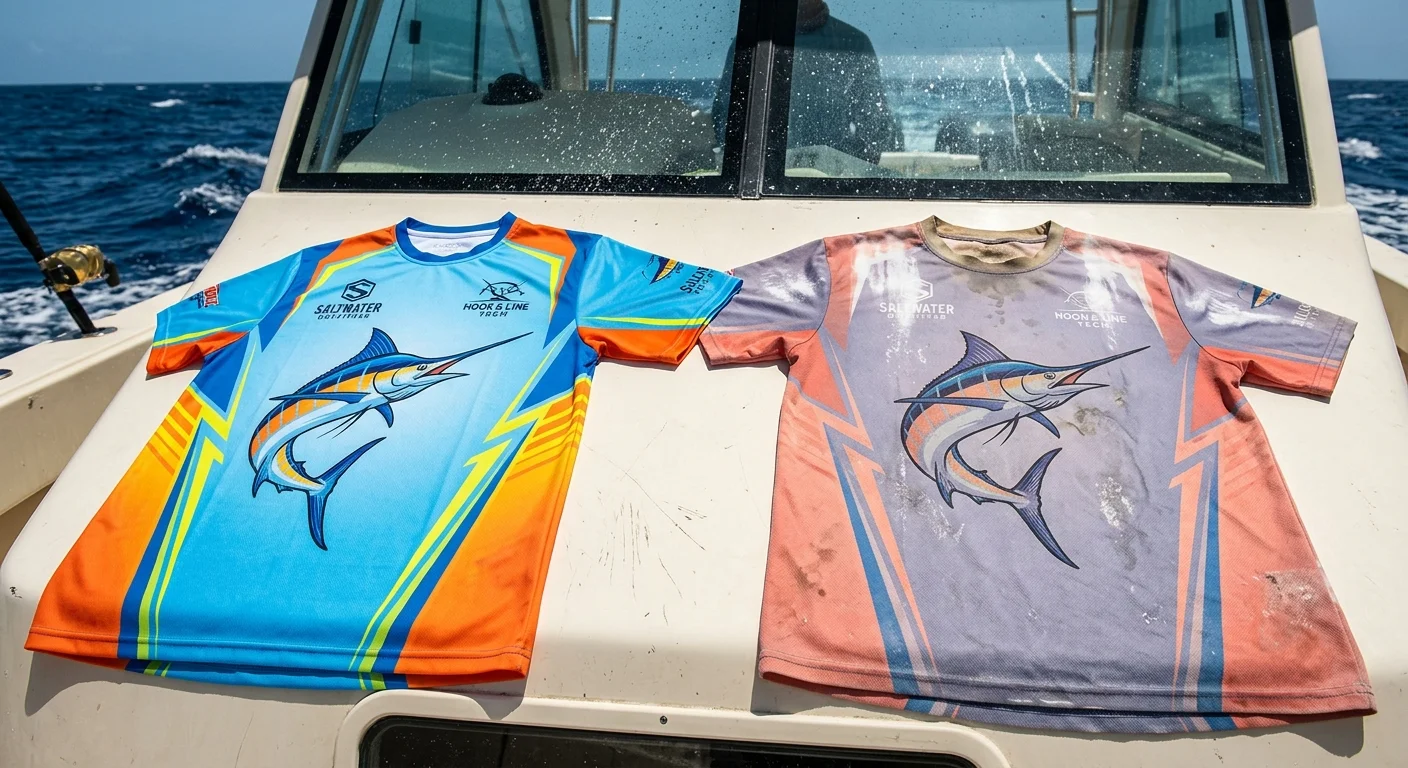
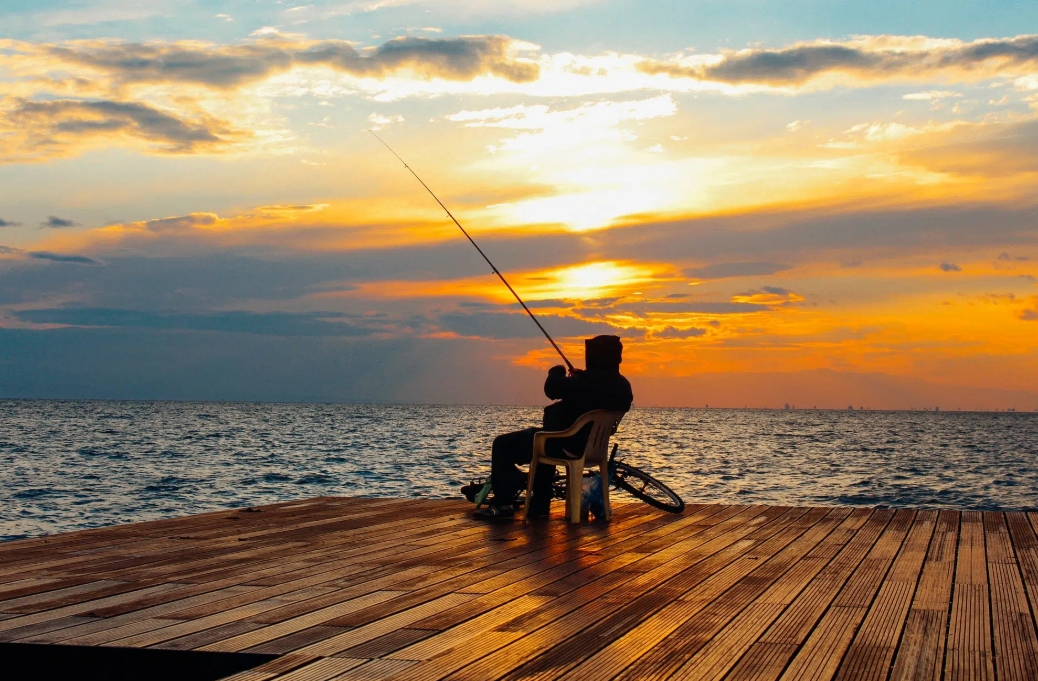
Sunlight is the most patient destroyer in offshore fishing. It doesn't announce itself. It just shows up every trip, stacking UV damage hour by hour until the graphics that once popped on your jersey look like they've been left on a dashboard for a decade.
ISO 105-B02 and AATCC 16 are the two standards built to measure how fast that destruction happens — and whether your sublimated fabric can outlast it.
How the Xenon-Arc Test Works
Both standards use a xenon arc lamp to simulate natural daylight (D65 spectrum). The lamp doesn't just blast light. It replicates the full spectral range of solar radiation that breaks down dye molecules in polyester sublimation ink.
Key operating parameters to know:
Irradiance control point : ISO 105-B02 runs at 42 W/m² across 300–400 nm , or 1.10 W/m²/nm at 420 nm — labs pick one based on their equipment setup
AATCC 16 controls irradiance and ends tests by accumulated radiation dose (AFU — AATCC Fading Units) , not a fixed clock time
Black panel temperature : held at 60 ± 2°C , matching fabric surface heat under direct midday sun
Sample size : AATCC 16 requires a minimum of 70 mm × 120 mm , with at least 3 replicate specimens
The test runs your sample and a Blue Wool reference standard (grades 1–8) side by side under identical exposure. Blue Wool fades at a known, predictable rate. So you read the fabric's fade resistance straight against it.
Reading the Results: Blue Wool + Grey Scale
The grading system has two layers working together.
The Blue Wool scale shows relative fade speed — Blue Wool 1 fades fastest, Blue Wool 8 holds the longest. A sublimated polyester jersey at acceptable quality should hold above Blue Wool 5–6 before any meaningful color shift appears.
The Grey Scale converts that fade into a 1–5 numeric grade:
Grey Scale Grade | What It Means in Practice |
|---|---|
5 | No visible color change — excellent |
4 | Slight change, acceptable for most commercial applications |
3 | Noticeable change — marginal; context-dependent |
2 | Significant change — rejection territory |
1 | Severe fading — complete failure |
Minimum pass grade for fishing jersey applications: Grey Scale 4. For offshore and tournament-grade garments, push that floor to 4–5 .
What a Compliant Test Report Must Include
A fishing jerseys supplier handing you a single "Pass" stamp on a test certificate gives you almost nothing you can audit. A legitimate xenon-arc test report needs every one of these fields:
Lamp model, filter configuration, irradiance setpoint (420 nm or 300–400 nm band)
Sample mounting method, exposed area, number of replicate specimens
Blue Wool reference grade aligned alongside sample results
Grey Scale rating with before/after color records
Cumulative irradiation dose (kJ/m²) or total AFU with the defined stop criterion
Full irradiance curve log, plus temperature, humidity, and spray cycle records
No cumulative energy figure means you can't compare results across labs. A Grade 4 at 20 AFU is not the same as a Grade 4 at 80 AFU. Demand the raw exposure log.
Ink System Performance: Aqueous vs. Outdoor-Grade Sublimation
Not all sublimation inks age at the same rate under xenon exposure. As a sourcing benchmark:
Standard aqueous sublimation inks : score around Grey Scale 3.5–4.0 in xenon-arc testing
Outdoor-grade/high-durability sublimation inks : reach Grey Scale 4.0–5.0
These ranges are industry-level reference figures. Actual results shift with ink formulation, transfer temperature, dwell time, and PET content in the base fabric. For procurement, the key question is this: can your fishing apparel supplier show you the original fade curve with cumulative irradiation mapped against Blue Wool and Grey Scale readings ? A single number on its own isn't auditable. Ask for the curve. The curve doesn't lie.
Artificial Perspiration & Sweat Colorfastness Testing (ISO 105-E04)
Sweat is slow acid. Eight hours on the water, tournament pressure, equatorial humidity — your jersey doesn't just get wet. It gets attacked from the inside out.
ISO 105-E04 measures how much damage that attack does to sublimated polyester ink. It runs two separate formulas — acid perspiration at pH 5.5 and alkaline at pH 8.0 — because human sweat isn't constant. Fresh exertion sweat skews acidic. Prolonged heat pushes it alkaline. Offshore anglers produce both within a single trip.
The Test Chemistry and Setup
The acid perspiration formula isn't complicated. But precision matters:
Lactic acid : 1 g/L
Sodium chloride (NaCl) : 5 g/L
Disodium hydrogen phosphate (Na₂HPO₄) : 2.5 g/L
pH : 5.5 ± 0.2, adjusted with 0.1 mol/L NaOH
Liquor ratio : 1:50 (specimen to solution)
The alkaline formula follows the same structure at pH 8.0 ± 0.2 . One hard rule: your prepared acid solution reads outside pH 4.3 ± 0.2 ? Discard it and start over. ISO 105-E04 requires it. pH drift mid-test creates localized breakdown conditions. Results become useless.
Test assembly sequence:
Layer the test specimen against a multifiber adjacent fabric — this fabric contains cotton, polyester, polyamide, acrylic, wool, and acetate strips in a single sandwich
Immerse the composite for 30 minutes until fully saturated
Scrape off excess solution, then compress between glass plates at 4.5 kg load
Incubate at 37 ± 2°C for 4 hours — that's human skin temperature, by design
Dry at ≤60°C in moving air — higher temperatures risk extra sublimation migration that contaminates the result
Two Ratings, Two Different Failure Modes
ISO 105-E04 produces two separate scores. Treating them as one number is how sourcing mistakes happen.
Color Change (rated on ISO 105-A02 Grey Scale): this measures what happens to the original specimen — fading, hue shift, tone loss. It's the dye permanence score.
Staining (rated on ISO 105-A03 Grey Scale): this measures how much color moves into each fiber strip of the adjacent multifiber fabric. It's your cross-contamination score — relevant for base layers, skin contact, and life jackets.
Application Level | Color Change Minimum | Staining Minimum |
|---|---|---|
Freshwater / recreational | ≥ Grade 3–4 | ≥ Grade 3–4 (cotton, polyamide) |
Offshore / tournament / professional | ≥ Grade 4 | ≥ Grade 4 on all fiber strips |
Watch polyamide and cotton staining closely. Those two strips represent the fabrics most likely to sit against your jersey — base layers, harness padding, safety gear. A Grade 2–3 staining score on polyamide with fluorescent orange or deep navy ink creates a liability problem. That goes beyond a simple QC issue.
Why Sublimation Jerseys Fail This Test
Three production failures cause most ISO 105-E04 rejections in sublimated fishing apparel:
1. Insufficient transfer pressure. Sublimation transfer below ~0.3 MPa leaves dye molecules stuck in the surface zones of polyester. They never reach the crystalline core. At 37°C with physical movement, those surface dyes release. The result: staining grades of ≤3, particularly on cotton and polyamide strips.
2. High spandex content (>8%). Elastane blends break up the crystalline structure of polyester and open small internal channels. Warm artificial perspiration pushes unfixed dye through those channels into adjacent fabrics faster. Staining grades fall to 2–3 in constructions that aren't well-optimized. Your jersey spec includes stretch fabric? Test this failure mode hard during sampling.
3. Fabric PET content below ~85%. Virgin polyester with high crystallinity traps disperse dye in stable zones — perspiration fastness grades of 4–5 are reachable. Blends that dilute PET density, or recycled PET with uneven crystalline structure, weaken that stability. Both color change and staining scores drop as a result.
For offshore-grade jerseys, the fix is direct: check transfer pressure logs from production runs, confirm PET content in fabric certification, and run E04 testing against both acid and alkaline formulas before you approve bulk.
Saltwater & Marine Environment Immersion Testing (ISO 105-E02)
Salt doesn't just fade fishing jerseys. It moves inside the fibers, crystallizes, and then lets UV finish the job.
That's the failure mode ISO 105-E02 is built to catch. The test runs on a different setup than the perspiration protocol. ISO 105-E04 copies body chemistry at skin temperature. E02 copies ocean immersion: 3.5% w/v NaCl in deionized water , ambient temperature (20–25°C), pH holding around 7.8–8.2 with no forced adjustment.
Test Setup and Procedure
The specimen setup mirrors E04. Test fabric gets sandwiched against a multifiber adjacent fabric (standard 10 × 4 cm composite), sewn together, then dropped into the solution at a 50:1 liquor ratio for 30 minutes.
After immersion, drain the solution. Pass the composite between two glass rods to pull out excess liquid. No wringing. No hard pressing. Then place it between glass or acrylic plates under 12.5 ± 0.9 kPa pressure and move it into a 37 ± 2°C oven for 4 hours . Final drying: hang each piece apart in air, or use an oven at ≤60°C .
Labs sometimes miss this: any specimen showing signs of drying during the 4-hour compression stage must be discarded . A sample that dries too early under pressure builds localized salt concentration zones. Those zones skew your results in the wrong direction.
Minimum Pass Grades
Rating Dimension | Minimum Pass Grade |
|---|---|
Color change (test specimen) | ≥ Grade 4 |
Staining (each multifiber strip) | ≥ Grade 4 |
Salt bloom / surface crystallization | None visible at normal viewing distance |
Report staining grades by each fiber type — cotton, PET, polyamide, acrylic as separate scores. A combined "pass" that hides a Grade 2–3 on polyamide is a real problem. It shows up later on boat harnesses and life vests where it matters most.
Why Sublimated Jerseys Fail ISO 105-E02
The failure mode that trips up most Sublimated fishing jerseys suppliers is salt crystal micro-expansion . A salt-saturated jersey dries under heat. NaCl recrystallizes inside fiber micropores. Those crystals push dye molecules out of their sublimation-bonded positions. Then UV breaks down what remains. Three stressors. Running back to back.
Two production-level fixes tackle this problem head-on:
Cationic fixing agent at 0.3–0.5% owf during wet finishing closes fiber micropores and builds stronger dye-fiber ionic bonding. This cuts salt solution ingress at the source.
HALS (Hindered Amine Light Stabilizer) at ~0.8% by ink weight during ink preparation blocks photo-oxidative free-radical chain reactions. Salt crystals trigger those reactions. HALS shuts them down.
For offshore-grade jerseys, both fixes are required. They target different failure points — one stops salt ingress, the other controls UV breakdown. Together, they push results from Grade 3 to Grade 4–5 in accelerated marine cycling tests.
Accelerated Marine Cycling: Beyond the Standard Single Cycle
Single-cycle ISO 105-E02 gives you a baseline. For offshore tournament apparel, run a 3–5 cycle accelerated protocol before you approve bulk production:
Phase 1 : 4-hour immersion in 3.5% NaCl at 25°C
Phase 2 : 65°C forced-air drying for 2 hours (drives active NaCl crystallization)
Phase 3 : Repeat 3–5 full cycles; grade after the final cycle
The 65°C drying temperature goes above the standard's ≤60°C limit. That's the point. The extra heat forces crystallization stress into the fabric the same way repeated offshore days do in real use. A jersey that holds Grade 4 color change and Grade 4 staining across five full cycles of this protocol — that's a jersey worth putting your name on.
Sublimation Fade Failure Root Causes & Process Optimization Parameters
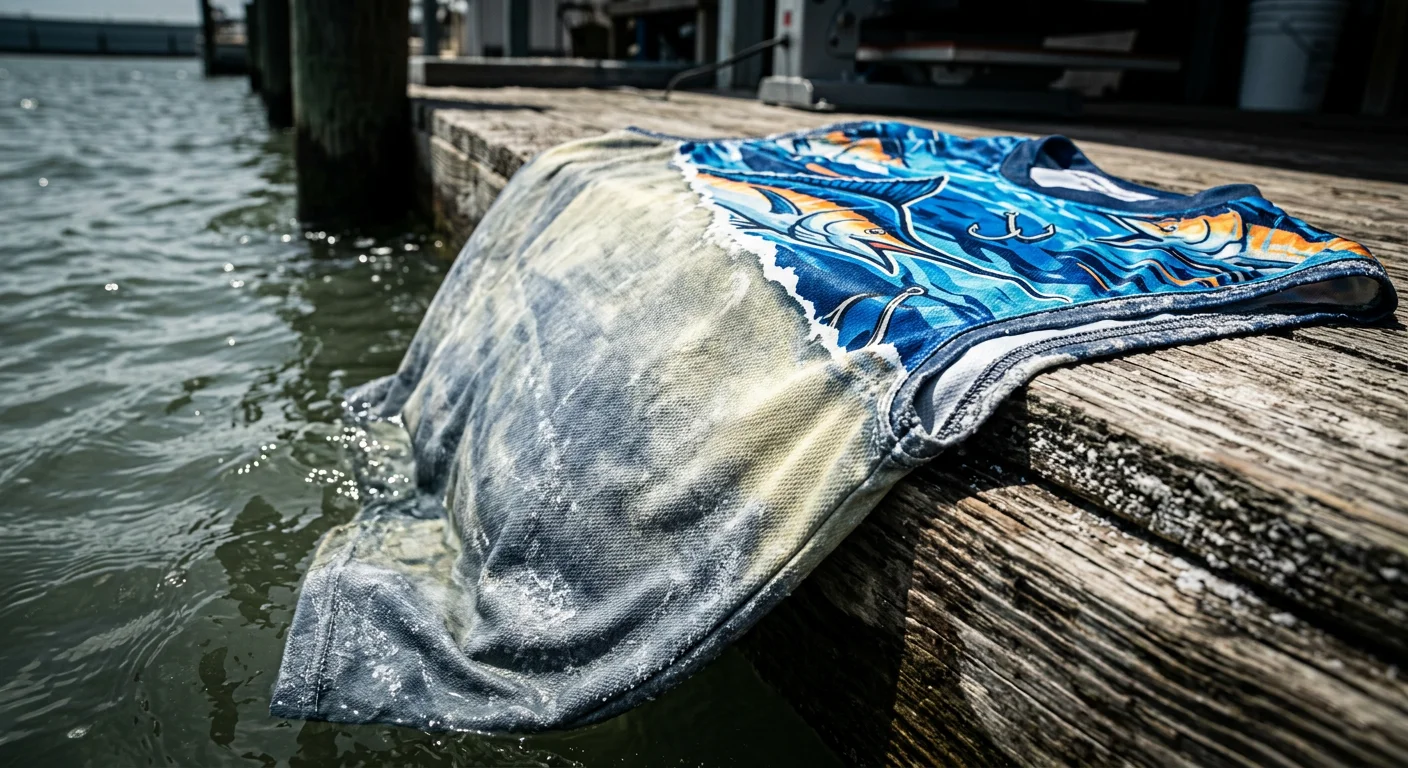
Three production variables kill more fishing jerseys than any offshore environment ever will. Sunlight, salt, and sweat get the blame. The press operator, the fabric spec sheet, and the ink purchase order deserve most of it.
Every fade failure in sublimated fishing apparel traces back to one of three root causes. Fix these at the source and your colorfastness grades climb. Ignore them and no amount of retesting changes the outcome.
Root Cause 1: Heat Press Parameters Outside the Transfer Window
Sublimation leaves no room for guessing. The working window is tight: 195–205°C , 45–60 seconds , 0.6–0.9 bar pressure .
Go below 190°C on lightweight knit fabric and dye migration stops short. The molecules never gasify. They never reach the polyester crystal structure. Instead, they sit near the fiber surface and wash or sweat out later. Push above 210°C and you create two new problems: fiber damage and yellowing.
Pressure distribution matters as much as temperature. A press with a platen temperature variance greater than ±3°C across its surface creates fade patches. The center of your jersey grades at 4. The edges grade at 2–3. That's a uniformity clause violation before the garment ever hits water.
For lightweight and stretch constructions, run pressure toward the lower end of the 0.6–0.9 bar range . High pressure on thin fabric compresses the fiber structure. That creates uneven dye migration depth.
Root Cause 2: PET Content, Crystallinity, and Fabric Specification Failures
Disperse dye sublimation relies on the crystalline structure of polyester to trap and hold dye molecules. Weaken that structure and your colorfastness grades drop with it.
The procurement spec is clear: 100% virgin polyester is the stable baseline for offshore fishing jerseys. Recycled PET brings crystalline inconsistency. Spandex blends open internal fiber channels that warm perspiration then exploits. Any fabric spec below 85% PET should trigger a re-evaluation before sampling starts.
One process control step gets skipped far too often: condition your fabric at 40–45% relative humidity for 24 hours before transfer . Moisture in the fabric disrupts dye migration. It creates ghosting, uneven color density, and surface-level ink deposits. Those deposits fail perspiration testing within a single ISO 105-E04 cycle.
Root Cause 3: UV + Salt/Sweat Synergistic Degradation
Disperse dyes carry no built-in UV resistance. That's not a flaw in sublimation chemistry — it's just physics. Offshore fishing makes it worse by stacking all three stress factors at once. UV radiation breaks down dye molecular bonds. Salt crystals act as catalysts that speed up photo-oxidation. Sweat residue changes the surface chemistry of the fiber.
The degradation sequence is predictable. Color shifts gray first. Saturation drops. Then localized tone distortion appears — most often on the shoulders and chest panels, where UV and salt exposure peak on a fishing jersey.
Outdoor-grade UV sublimation inks target this failure directly. The performance gap versus standard aqueous inks shows up clearly at the bench:
Process Variable | Before Optimization | After Optimization | Colorfastness Gain | Complaint Rate Drop |
|---|---|---|---|---|
Transfer Pressure | 0.2 MPa | 0.38 MPa | +0.8 Grade | 62% |
Ink System | Standard Aqueous | Outdoor UV-Grade | +0.6 Grade | 45% |
Fabric PET Purity | 88% (with spandex) | 100% Virgin Polyester | +1.0 Grade | 78% |
Study the PET purity row closely. One change in fabric specification — swapping a spandex blend for virgin polyester — delivers +1.0 Grey Scale grade and cuts customer complaints by 78% . No ink upgrade. No press recalibration. Just the fabric.
The Optimized Process Parameter Window
Add these numbers to your production SOP and your supplier audit checklist:
Temperature : 195–205°C
Dwell time : 45–60 seconds
Pressure : 0.6–0.9 bar (use the lower end for stretch/lightweight constructions)
Pre-transfer fabric conditioning : 40–45% RH, minimum 24 hours
Post-transfer handling : avoid direct UV exposure and high humidity during the curing and quality-check window
These aren't stretch targets. They're the baseline operating conditions that keep sublimation dye where it belongs — locked inside the polyester crystal structure, not bleeding into a multifiber adjacent fabric strip on your next ISO 105-E04 run.
DIY Pre-Screening Protocol: Saltwater Soak & Direct Sun Exposure Test
Third-party lab testing costs money. A full ISO 105 panel from a certified textile lab runs $300–600 per sample set. Small buyers ordering trial quantities — or comparing three competing suppliers at once — often can't justify that cost before seeing a single bulk swatch.
This protocol gives you a structured pass/fail screen. Total materials cost: under $20. It won't replace ISO 105-B02 or E02. But it cuts the obvious failures before they cost you a lab invoice.
What You Need
35 g/L saltwater solution — food-grade coarse salt or industrial sea salt in a stainless or plastic basin. The basin needs to be deep enough to submerge samples fully. That concentration matches the 3.5% NaCl baseline used in ISO 105-E02.
Waterproof PVC masking tape — must hold 24 hours submerged without lifting or releasing adhesive into the fabric.
100% plain-weave white cotton cloth , 120–150 g/m², no optical brighteners, no pre-treatment. This is your friction staining reference.
UV Index meter — cheap portable units work fine. You need to confirm your exposure site hits UV Index ≥6 before you start the clock.
Cut 2–3 specimens per colorway : 10 cm × 20 cm, edges heat-sealed or serged. Mark each one with batch number, color, and date using a waterproof pen.
Step 1: Saltwater Immersion (24 Hours)
Submerge half of each specimen — 10 cm down, 10 cm dry above the waterline. Place a glass plate or stainless mesh on top to stop it floating. Let it sit at room temperature for 24 continuous hours .
After immersion, lift the specimen and press out surface water without wringing. Hang it in shade with airflow until dry. Keep it out of direct sun at this stage — you're isolating the salt variable, not adding UV exposure on top of it yet.
Flag right away any specimen showing coating delamination, visible color bleed into the solution, or surface chalking before sun exposure even starts. That's a high-risk rejection no matter what comes next.
Step 2: Direct Sun Exposure (Cumulative ≥20 Hours)
Place a 3 cm × 10 cm strip of waterproof tape down the center of each specimen's face. That taped strip is your zero-exposure reference. Everything on either side gets full UV.
Pin specimens face-up on a rigid white board — no shade, no partial coverage. Shift the board's angle during the day to keep the fabric surface close to perpendicular with incoming solar radiation. Run tests during the 10:00–14:00 window only — that's when UV Index peaks. Check your UV Index reading at the sample location before each session.
Target: 72 hours total real-time exposure, or at least 20 cumulative hours of direct UV Index ≥6 irradiance. Cloudy days don't count. Partial cloud cover doesn't count. Log each session: start time, end time, UV Index range observed.
Keep the samples dry throughout this phase.
Step 3: Dry and Wet Crocking Check
Sun exposure done? Run a quick friction test on the area with the most visible color change.
Cut two pieces of white cotton cloth at 5 cm × 10 cm. Keep one dry. Dampen the second with distilled water until evenly moist — not dripping.
Wrap each cloth over a fingertip or small wooden block. Press down with about 5 N of downward pressure and make 10 back-and-forth passes along a 5–7 cm straight line. Do the dry cloth first, then the wet cloth on a fresh surface area.
Photograph both friction cloths flat against a neutral grey background under north-facing window light or a D65 lightbox.
Simplified staining scale:
Level | What You See |
|---|---|
0 | No visible transfer |
1 (Trace) | Faint shadow, visible only under close inspection |
2 (Moderate) | Visible within 1 m, doesn't dominate the white cloth |
3 (Fail) | Visible at arm's length — close to Grey Scale 3–4 staining equivalent |
Reading the Results
Peel the masking tape. Under D65 light or north-facing daylight, place the three zones side by side: taped reference strip vs. sun-exposed area vs. salt-immersion half.
Verdict | Criteria |
|---|---|
Pass | Sun vs. reference: color difference is hard to spot, estimated ≥Grade 4. Salt zone: no extra fade or delamination. Dry + wet crocking: Level 0–1 only. |
Borderline | Color difference visible but not dramatic — estimated Grade 3–4. Pull a larger swatch from the same production batch and send it for formal ISO 105-B02 / E02 testing before placing a bulk order. |
Fail | Obvious fade, grey shift, or hue distortion at normal viewing distance — estimated |
One hard rule: any wet crocking at Level 2 or above triggers automatic rejection — even if the sun exposure grades look fine. Crocking that bad points to unfixed surface dye. That's the same dye that transfers onto boat harnesses, life vests, and skin contact layers out in the field.
This screen runs about 72 hours of total elapsed time and around 45 minutes of actual hands-on work. It won't give you a lab-certifiable number. What it does give you is a fast, low-cost way to see which samples are worth the full test budget — and which ones to cut right now.
Procurement QC Checklist & Contract Specification Template
A supplier who can't produce paperwork doesn't deserve your purchase order. Full stop.
All those specs from the previous sections — the xenon-arc grades, the E04 staining scores, the marine cycling results — mean nothing until they're written into your contract as enforceable language. Below is the full checklist. Drop it straight into your supplier agreement or factory audit form.
Colorfastness Standard Minimums (Contract-Ready Language)
Write these exact thresholds into your acceptance clause:
ISO 105-B02 (light fastness): finished garment ≥ Grade 4
ISO 105-E04 (perspiration): ≥ Grade 3–4 color change; ≥ Grade 4 staining
ISO 105-E02 (seawater): both color change and staining ≥ Grade 4
Add this sentence word-for-word: "Each production batch requires fabric samples meeting all minimum grades above; failure on any single dimension constitutes a quality non-conformance and triggers full batch rejection."
Deep colors — navy, black — and any fluorescent colorway are high-risk colors . Test them at double frequency. Standard colors: once per batch. High-risk colors: twice per batch.
Ink & Fabric Specification Locks
On ink:
The supplier must provide a complete MSDS for every sublimation ink used. This covers Sublimated Fishing Jerseys manufacturer name, SKU, VOC content, storage conditions, and hazard classification.
Outdoor-grade polyester sublimation inks are the standard. General-purpose dyes and non-sublimation inks are banned by contract.
Every bulk batch must record the ink lot number, production date, and internal formula code . Cross-reference each to the matching colorfastness test report.
Ask the supplier's ink vendor for xenon aging data. You need ΔE and grade change curves at 500–1,000 hours. That light stability batch number belongs in your contract's technical annex.
No recycled or downgraded pigment pastes. Get the original Sublimated Fishing Jerseys factory COA (Certificate of Analysis) showing metal impurities, VOC levels, and solid content. No COA means the batch stays out of production.
On fabric:
Lock the spec to 100% virgin polyester . Confirm it through third-party fiber analysis — combustion method plus FTIR.
Two things are banned outright: uncertified rPET and any spandex blend above 5% in main body panels .
Stretch fabric has its place — cuffs, side inserts. Your contract must define exactly where and set a hard cap: "Accessory panels: max 90% PET / 10% spandex. Main body: 100% virgin PET, no exceptions."
Physical spec parameters to lock in: weight 150–180 g/m² (±5% tolerance) , breaking strength ≥ 300 N warp and weft, pilling resistance ≥ Grade 4 .
Sampling & AQL Parameters
Defect Category | AQL Level |
|---|---|
Major defects | 2.5 |
Minor defects | 4.0 |
Sampling follows batch size per ISO 2859. For dark or fluorescent colorways, double the sample count. A standard color that pulls 80 pieces means the high-risk color pulls 160. Focus inspection on: color inconsistency, bleed-through, migration, edge definition, and abnormal crocking.
On-Site Color Assessment Setup
The factory floor or finished goods inspection area needs two specific pieces of equipment. No substitutes:
D65 standard lightbox with D65/TL84/UV modes
ISO 105 grey scale cards for both color change and staining assessment — clean, calibrated, and replaced on schedule
Document every lightbox calibration. The minimum gap between calibrations is six months . Keep all records on file.
For production color matching, measure against the approved strike-off using a spectrophotometer. ΔE ≤ 2.0 is the pass threshold, based on L , a , b* comparison. Any batch that goes over that tolerance gets quarantined for re-inspection. Two consecutive out-of-tolerance batches equals a batch failure.
Third-Party Testing & Sample Retention
Every bulk shipment needs a minimum of three 50 × 50 cm fabric samples pulled from the production batch:
Sample 1: full colorfastness panel — light, perspiration, seawater
Sample 2: fiber composition and physical properties check
Sample 3: held in reserve for dispute retesting
Use accredited labs only: SGS, Bureau Veritas (BV), or Intertek — any facility with a certified textile testing scope.
Retained samples must include at least one finished garment per colorway per size, plus three fabric swatches labeled with batch number, date, and color code. Store everything for no less than 12 months from the shipment date. Log the storage environment: temperature, humidity, and location. Cross-season disputes rely on this data — skip it and you lose your evidence.
Breach Conditions & Remedies
Any of the following puts the contract in breach:
ISO 105-B02 result < Grade 4
ISO 105-E04 < Grade 3–4, or ISO 105-E02 < Grade 4 on any dimension
Visible large-area fading or graphic distortion that affects brand presentation
Detection of undisclosed rPET or out-of-spec spandex content
Supplier liability on breach:
100% remake costs — fabric, print, cut and sew
Round-trip freight — return shipment plus redelivery, both at the supplier's expense
Third-party retest fees — all lab costs from the dispute go to the supplier
Optional: add a liquidated damages clause tied to a percentage of contract value, covering downstream customer cancellations
Shipment Documentation Package
Every delivery — physical or electronic — must include:
Xenon aging curve report (batch-specific) : test standard, duration, temperature/humidity log, ΔE over time, grade progression, and sample appearance photos. Batch number and ink lot must be cross-referenced throughout.
High-resolution grey scale comparison photos from ISO 105-E04 and E02 testing: specimen against grey scale card, with file names showing sample ID, test date, and lab name.
Heat press calibration logs : every transfer machine used in production — temperature setpoint vs. actual, pressure, dwell time, maintenance schedule, and last calibration date.
No documentation package, no payment release. That's the clause. Write it in.
Conclusion
Color doesn't lie — and neither does a grey scale rating under proper test conditions.
Running through ISO 105-B02 xenon arc exposure, perspiration fastness protocols, and saltwater immersion cycles reveals a clear pattern. Most sublimation colorfastness failures aren't material problems. They're process problems. Undertreated polyester, insufficient transfer temperature, and salt-accelerated UV degradation are all preventable. You just need to know what you're testing for and what the numbers mean.
Take three things with you:
Write your minimum pass grades into every custom Sublimated Fishing Jerseys supplier contract (≥4 for sunlight and saltwater, ≥3-4 for perspiration)
Know the three root-cause failure modes that drive the vast majority of field complaints
Run the DIY pre-screening protocol — it costs nothing but an afternoon
The real offshore fishing apparel durability test doesn't happen in a lab. It happens at mile marker 40, under full sun, soaked in brine.
Make sure your jerseys are ready for it.