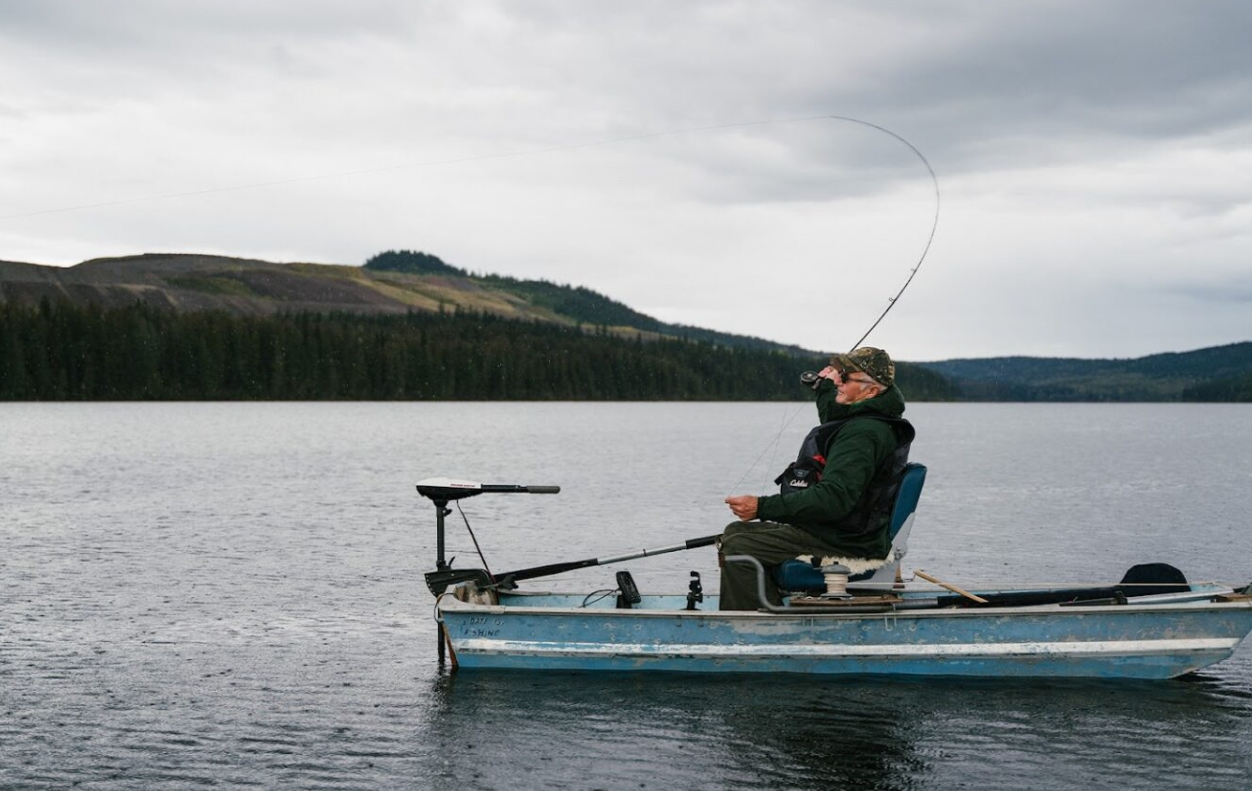
You're soaking wet before you've even baited your first hook. The real question isn't whether it'll rain offshore — it's whether your rain gear holds up when a 30-knot squall turns the deck into a washing machine.
Grundéns has outfitted commercial fishermen in brutal North Atlantic conditions for decades. Frogg Toggs promises "good enough" waterproofing at a fraction of the price.
But here's what nobody tells you: "good enough" on a bass pond and "good enough" fifteen miles offshore are two different things.
Professional fishing rain gear manufacturers use these performance factors to develop offshore-ready products.This breakdown goes beyond spec sheets. You'll get:
A six-dimension performance scorecard built for offshore conditions
A real cost-per-trip ROI analysis
A model-specific matchup between the Grundéns Weather Watch and the Frogg Toggs All Sport
Walk away with a clear purchase decision — not more confusion.
Real-World Offshore Waterproof & Wind Resistance Test (30+ Knot Gusts)
Thirty-five knots of crosswind doesn't care about your gear's marketing copy.
Here's what the test looks like: sustained 30–35 knot crosswinds, direct bow-wave splash, continuous heavy squalls, and a 2–4 hour watch cycle on an open deck with zero shelter. No retreating to the cabin. No mid-watch gear swap. That's what offshore fishing demands — and that's the standard we're holding both brands to.
What "Waterproof" Really Means Offshore
Most rain gear uses hydrostatic head ratings. General outdoor gear hits 10,000–15,000 mm — fine for hiking in moderate rain. Offshore fishing professionals want 25,000–30,000 mm minimum. Wind-driven spray and constant physical movement create localized pressure that pushes water through lower-rated shells.
Reliable fishing apparel factories test waterproof ratings before large-scale production.Keep that number in mind as we break this down.
Grundéns: Built to Stay Dry When It Gets Ugly
The Grundéns Weather Watch uses ≈300-denier heavy nylon with a PU coating . The fabric is dense enough to resist wind-induced flutter. Without that density, flutter pumps water straight through seam gaps. The result:
Double storm flap over the main zipper blocks direct spray at the most common failure point
Taped seams seal every stitch hole against bending and kneeling pressure
Adjustable hook-and-loop cuffs cinch tight enough to stop water wicking up your forearms
In real 30+ knot conditions with continuous bow-wave splash, the interior stays dry across a full multi-hour watch . No wet strip along the zipper. No creeping dampness at the cuffs. Just consistent dryness — and that's what you need when failure isn't an option.
Frogg Toggs: Where the Gaps Show Up
The Frogg Toggs All Sport's lightweight polypropylene shell tells a different story. Above 25 knots, thin shells flutter, balloon, and lift . That flutter creates pressure cycles that stress seams and push water through closure overlaps.
The specific failure points in offshore conditions:
Single storm flap design (versus Grundéns' double) lets water wick along the zipper tape within 1–2 hours of heavy squalls
Elastic-only cuffs loosen with repetitive rod-and-reel motion. Spray tracks straight up your forearms
Hem lift in strong crosswinds opens the waist gap. This gets problematic fast without a tight overlap with bibs
Even the upgraded FTX Armor line (rated 10,000–15,000 mm) sits at or below the threshold for prolonged offshore exposure. Light spray and intermittent rain? It holds up. Continuous heavy squalls with driven spray over 2+ hours? Expect progressive dampness at the zipper and cuffs — plus a constant battle of readjustment.
Side-by-Side: 30+ Knot Performance Scorecard
Factor | Grundéns (Weather Watch) | Frogg Toggs (All Sport / FTX Armor) |
|---|---|---|
Shell fabric | ≈300D heavy nylon + PU | Thin non-woven / ≈150D polyester |
Waterproof rating | ≈10,000 mm (non-breathable PU) | Unrated–15,000 mm |
Seam construction | Sealed, commercial-grade | Sealed on lighter fabric; flutter stress |
Storm flap | Double flap, tight closure | Single flap, wicking risk |
Wind behavior at 30+ knots | Stable, minimal flutter | Flutter and ballooning above 25 knots |
2–4 hr heavy squall result | Interior stays dry | Damp at zipper/cuffs; needs readjustment |
The Bottom Line on Wind and Water
In sustained 30+ knot offshore conditions , Grundéns keeps the interior dry through solid construction — not just spec-sheet numbers. The non-breathable PU and heavy fabric combination punch above the nominal 10,000 mm rating in real-world driven spray.
Frogg Toggs works as an emergency backup or tactical mid-layer under a heavier shell. Use it as your sole outer layer in a serious offshore squall? It will let you down before lunch.
Salt Spray Corrosion Resistance & Seam Durability Tracking
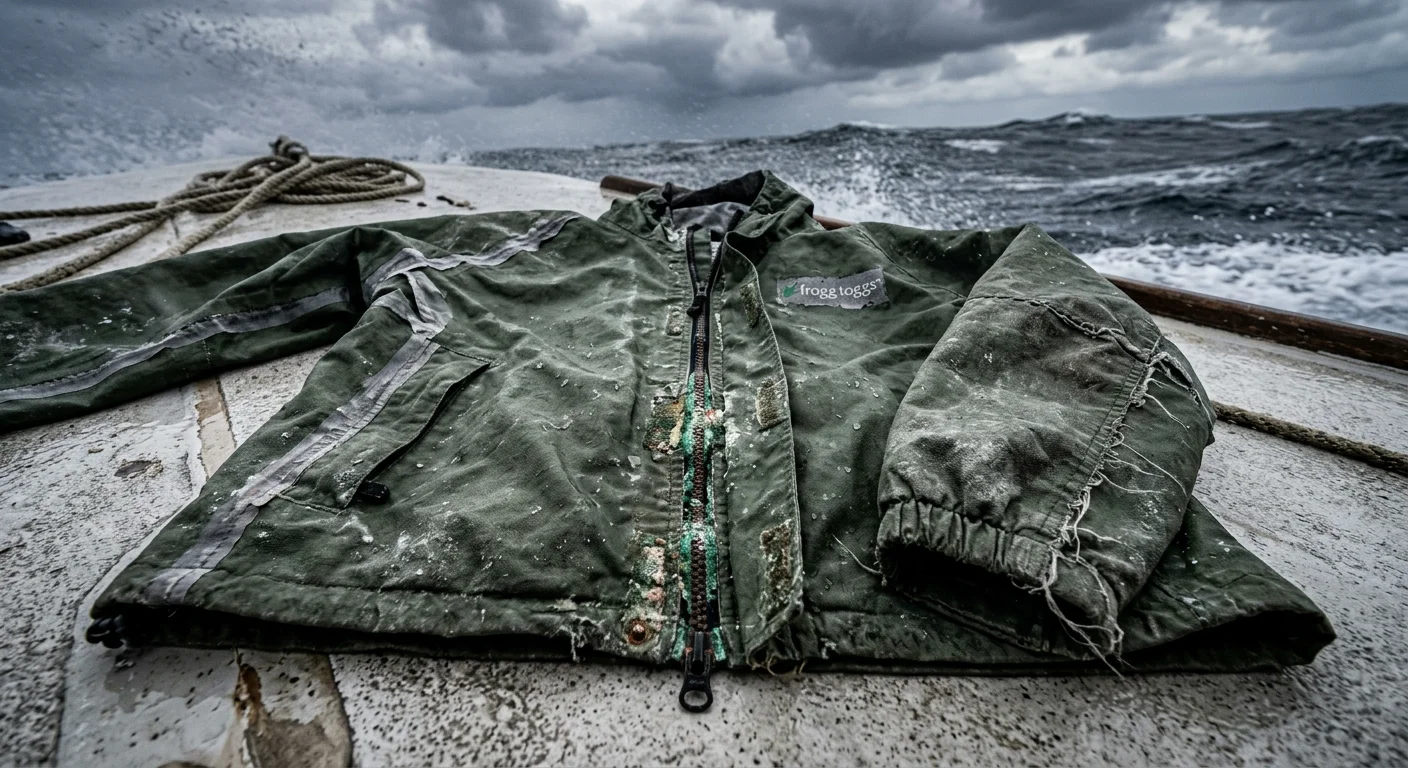
Salt doesn't just soak your gear — it attacks it. Trip after trip, zippers seize, seam tape lifts, and stitching unravels at the worst possible moment.
Most gear reviews skip this durability dimension entirely. Yet it's the one that determines whether your rain suit lasts one season or five.
Here's the science behind it: industry-standard salt spray testing (ASTM B117 / ISO 9227) uses a 5% NaCl solution at 35°C to simulate marine atmospheric exposure. For offshore-grade hardware — zippers, snaps, D-rings, adjusters — the benchmark targets are:
Recreational offshore use: ≥720 hours NSS (equal to 5–7 years of coastal service life)
Commercial deck work: ≥1,000 hours NSS minimum
Extended high-salinity exposure: 1,500+ hours NSS
This is where the two brands go in opposite directions.Many outdoor brands rely on OEM/ODM fishing jacket services to improve marine durability.
Grundéns: Hardware and Seams Built for the Long Game
Grundéns' construction meets the ≥720-hour NSS threshold. The ≈300-denier PU-coated nylon shell uses proper pretreatment and a 60–80 μm coating thickness. That resists blistering, cracking, and edge corrosion around cut and sewn areas through 240–720 hours of accelerated salt exposure. Factory-taped critical seams use commercial-grade tape. It stays intact well past the 240–480 hour accelerated exposure mark.
The hardware spec matters here too. Marine-grade zipper systems comparable to YKK AquaGuard — the class of hardware Grundéns specifies — target ≥480–720 hours NSS on sliders and pulls. Creepage from scribes stays under 1mm. In field conditions, that means well-qualified hardware shows no functional corrosion across 50+ offshore trips (around 300–400 hours of real-world salt exposure). That sits well below the 720-hour lab threshold.
One often-missed design detail: quality offshore gear adds a 0.8–1.5mm radius on sharp hardware edges . This prevents thin coating points and early edge rust at zipper stops and snaps near seams. That kind of spec-level thinking separates gear built for commercial fishermen from gear built for weekend anglers.
Frogg Toggs: Where Salt Wins Early
The Frogg Toggs All Sport's lightweight polyester shell tells a different story under salt exposure. Budget-grade polyester shells with minimal coating tend to hit visible degradation at 96–240 hours NSS — less than one-third of the offshore benchmark.
After 3 months of weekly trips (~72–96 hours of real salt exposure), here's what you'll see:
Surface chalking and UV-accelerated embrittlement on the shell fabric
Seam edge fraying at high-stress zones — knees, bib joints, the seat panel
Hardware jamming from corrosion buildup in zipper sliders
Tape lift at lightly-sealed seam sections, opening micro-gaps that get worse with each wet/dry cycle
Heat-welded or lightly taped seams without strong adhesive backing are the main failure point. Every offshore trip puts these seams through repeated salt wetting and drying cycles. The result: earlier tape lift and micro-tearing compared to factory-taped commercial-grade construction.
The 3-Month Reality Check
Metric | Grundéns (Weather Watch) | Frogg Toggs (All Sport) |
|---|---|---|
Effective salt spray tolerance | ≥720 h NSS | ~96–240 h NSS |
12-trip hardware condition | Zippers functional, no corrosion | Salt residue buildup, slider stiffening probable |
Seam tape adhesion (3 months) | Intact at critical stress zones | Lift detectable at high-flex areas |
Shell integrity under salt + abrasion | Coating intact, no base fabric exposure | Chalking and surface embrittlement starting |
Expected offshore service life | 3–5+ seasons with rinse maintenance | 1 season before seam/hardware degradation |
The numbers are clear. Three months of weekly offshore fishing puts you at around 96 hours of real salt exposure. Grundéns hardware and seams are rated for 7–8x that. Frogg Toggs materials sit at or near their degradation limit in that same window.
Rinse your gear after every trip — both brands benefit from it. But only one is built to survive the trips where you don't.
Casting Mobility & Sweat Management: Breathability PK
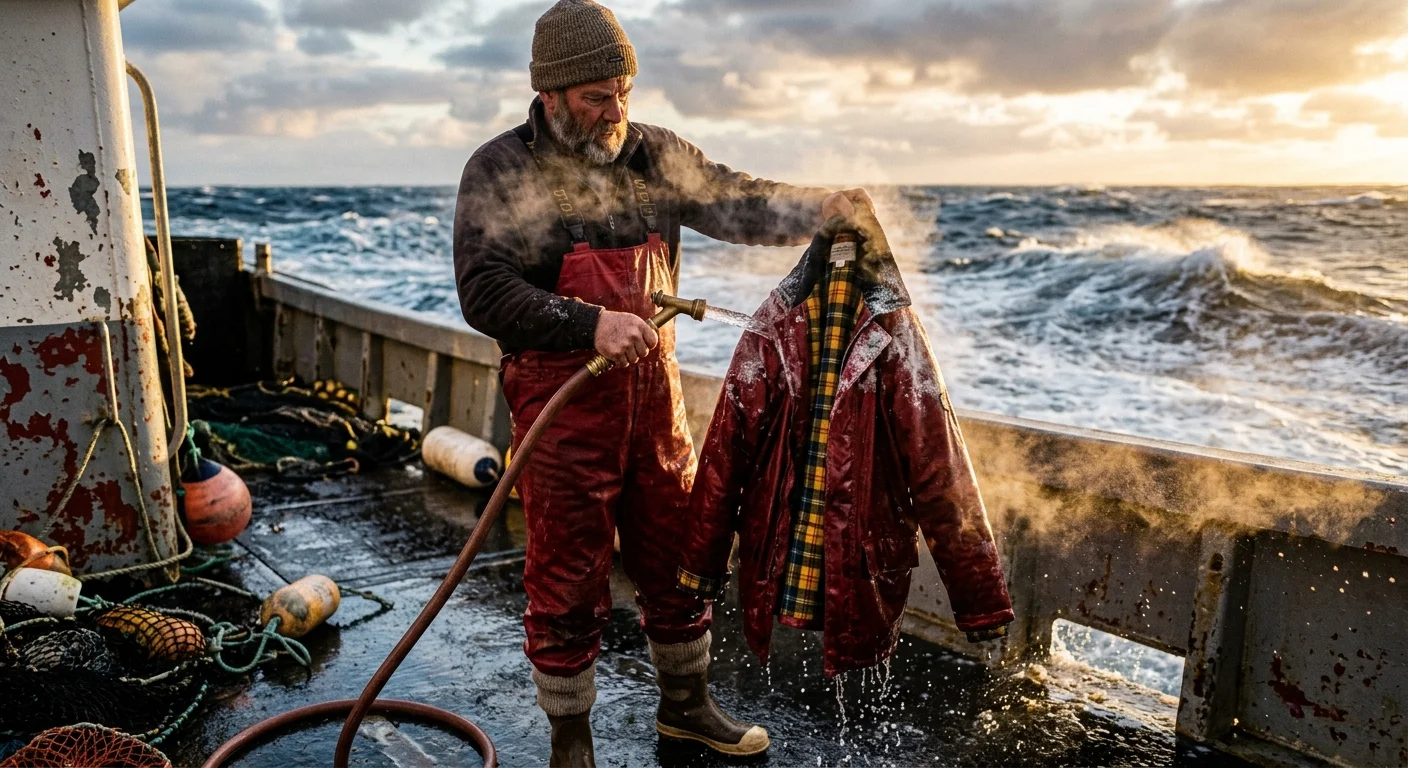
Staying dry from the outside is half the battle offshore. The other half is staying dry from the inside.
Here's the problem nobody talks about: you're casting hard, cranking heavy reels, and bracing against swells for hours. Tropical humidity sits above 80%. Your metabolic output stays steady-to-high the entire watch. At that output level, your rain gear needs to move 10,000–20,000 g/m²/24h MVTR worth of vapor out — or you end up soaked from your own sweat instead of the ocean.
That's where the two brands split hard.Custom fishing rain gear allows brands to adjust fit, fabrics, and features for specific waters.
Grundéns: Breathability Requires Active Management — But It Works
Grundéns PU-coated fishing shells in this price class land in the 5,000–10,000 g/m²/24h MVTR range. That's about half the output of premium GORE-TEX laminates. Not a dealbreaker. It's a management equation.
What makes it work offshore:
Pit-zips and core vents act as your primary sweat management tool once humidity climbs above 80%
Mesh-lined bibs allow open-zip airflow without direct water ingress
Articulated shoulders and harness-style suspension let the jacket and bib slide on their own — no torso ride-up during repeated overhead casts or heavy reel cranking
The casting mechanics matter here. Upper and lower pieces move on their own. Your back-cast reach stays full. Your fighting stance stays stable. The jacket doesn't bunch under your armpits mid-fight with a hard-running fish.
The protocol is simple: keep vents closed during spray, crack them open during dry intervals, and internal humidity stabilizes. It's a deliberate process — but once you manage it, internal dryness is recoverable and maintainable .
Frogg Toggs: Starts Comfortable, Collapses Under Load
The lightweight polypropylene shells — the ones in the core All Sport and Ultra-Lite2 lineup — test at a brutal 200–300 g/m²/24h MVTR in independent third-party data. That number isn't a typo. It puts these shells in the non-breathable category, against a GORE-TEX PacLite benchmark of 15,000+.
Even the upgraded FTX Armor line — marketed at 8,000–10,000 g/m²/24h — hits a ceiling fast in tropical offshore conditions:
No pit-zips on most shells; the main front zipper is the only vent
Casting and cranking drive your core temp up fast. Vapor can't clear fast enough
Inner surfaces wet out from condensation. Fabric clings to your forearms and shoulders , and that kills casting precision and tactile feel
The ultra-light material does give you real freedom of movement at the start of the trip. Finesse casting, quick deck repositioning, jigging — the low structural resistance feels great for the first hour. But baggy, unstructured cuts flap and balloon in gusty offshore wind . That kills fine casting control on long heavy throws.
Breathability Scorecard: Offshore Casting Conditions
Factor | Grundéns (PU Fishing Shell) | Frogg Toggs (FTX / All Sport) |
|---|---|---|
Effective MVTR (casting zones) | ~5,000–10,000 g/m²/24h | 200–300 g/m²/24h (lightweight); 8–10K claimed (FTX) |
Vent system | Pit-zips, core zips, mesh bibs | Front zipper only |
Inner surface behavior under hard fishing | Stabilizes with vent management | Condensation and cling after ~1hr sustained output |
Casting arc restriction | Minimal — independent bib/jacket system | Low initial resistance; degrades with wind and load |
Sweat management in >80% RH | Manageable with discipline | Collapses under sustained high output |
The Verdict
For light tackle or short sessions in cooler temps, Frogg Toggs' initial airflow advantage is real. In tropical offshore humidity with sustained rod work , that advantage has a short window — the first hour, before condensation takes over.
Grundéns demands zip discipline. Give it that, and your interior stays regulated through a full offshore watch. Frogg Toggs asks nothing of you — and the results show it.
6-Dimension Performance Scoring Table for Offshore Conditions
Six dimensions. Two brands. One offshore environment that punishes every weakness.
Wind behavior, salt corrosion, sweat management — everything from the previous sections feeds into this scorecard. These aren't random ratings. They pull from commercial charter use reports, published hydrostatic ratings, and real-world failure patterns across both product tiers.Experienced fishing apparel suppliers often use similar benchmarks when selecting technical fabrics.
Here's how Grundéns (Neptune / Deck Boss class) and Frogg Toggs (FTX Armor / Amphib class) stack up against what offshore fishing demands:
Dimension | Grundéns Score | Frogg Toggs Score | Offshore Verdict |
|---|---|---|---|
1. Waterproof Performance | 8–9/10 | 6–8/10 | Grundéns wins for sustained squalls and multi-hour deck wash |
2. Durability & Abrasion | 8–9/10 | 5–7/10 | Grundéns wins on commercial decks with constant gear contact |
3. Salt Corrosion Resistance | 9/10 | 6–7/10 | Grundéns dominates in high-salt, high-UV environments |
4. Breathability (MVTR) | 5–7/10 | 8–9/10 | Frogg Toggs wins on warm, humid offshore days |
5. Flexibility & Mobility | 7–8/10 | 8–9/10 | Frogg Toggs edges out for casting range and jigging |
6. Cost–Performance Ratio | 8–9/10 (long-term) | 8–9/10 (short-term) | Your trip frequency decides the winner |
What These Scores Mean in Practice
Waterproof (Grundéns 8–9 vs Frogg Toggs 6–8): Grundéns runs a PVC/PU-coated 230–300D shell with double storm flaps. It holds up through continuous deck wash without issue. Frogg Toggs' 120–150D woven shells handle burst rain fine. But under sustained spray, seepage shows up at the crotch, knees, and zipper interfaces. Grundéns hasn't started failing yet at that point.
Durability (Grundéns 8–9 vs Frogg Toggs 5–7): Grundéns is built for commercial fleets. You get reinforced knees, bar-tacked stress points, and industrial stitching. Plan on 3–5 seasons of hard offshore use. Frogg Toggs uses lighter fabric and consumer-grade stitching. Fraying and seam puckering show up within 1–2 tough seasons. The ripstop FTX variants push closer to 7/10, but still fall short of PVC-grade construction.
Salt Corrosion (Grundéns 9 vs Frogg Toggs 6–7): PVC/PU coating doesn't react to salt — that's just the nature of the material. Grundéns hardware uses plastic parts or treated alloys to extend service life in high-salinity conditions. Frogg Toggs' standard zippers and snaps collect salt crust and start jamming after 40–60 offshore days without regular upkeep.
Breathability (Frogg Toggs 8–9 vs Grundéns 5–7): Frogg Toggs takes this one — no contest. FTX Armor's microporous membranes push 10,000–20,000 g/m²/24h MVTR. That's a real edge during active casting and jigging in tropical conditions. Grundéns' traditional PU shells land at 5,000–10,000 g/m²/24h. You'll need to manage vents to stay comfortable past the 30–60 minute hard-work mark.
Mobility (Frogg Toggs 8–9 vs Grundéns 7–8): Frogg Toggs uses sport-oriented patterning. You get wider shoulder rotation and less elbow resistance. That matters for high-frequency casts and fast rail movement. Grundéns is cut for a working posture. It handles gaffing and hauling well, but feels a bit tight for athletic overhead casting in a full bib-and-jacket setup.
A fishing gear wholesaler should compare durability, not just initial purchase cost.Cost-Per-Trip ROI (Both 8–9, different time horizons): This is where the numbers shift — and it gets a full breakdown in the next section.
Who Should Fish in Which Gear
Grundéns (Neptune / Deck Boss tier) is the right call for:
- Charter skippers and deckhands running 30+ offshore trips per year
- Cold-front fishing, winter tuna runs, and heavy-chop conditions with constant green water on deck
- Anyone who can't risk gear failure — replacing soaked layers 40 miles out isn't an option
Frogg Toggs (FTX Armor / Amphib tier) makes sense for:
- Weekend offshore anglers doing 15–20 trips per year in warm, humid climates
- Casting-heavy styles — topwater for pelagics, popping, light jigging — where mobility and breathability shape fishing performance
- Budget-conscious buyers who need gear that works for inshore and surf fishing too
The scorecard is clear: Grundéns protects harder, Frogg Toggs moves easier. Your trip frequency and fishing style decide which one matters more.
True Long-Term ROI: Cost-Per-Trip Breakdown Analysis
The sticker price is a lie. The cost-per-trip number is what tells you what your rain gear really costs.
Here's the math most anglers never run:
A Grundéns mid-tier set (jacket + bibs, comparable to the Weather Watch / Neptune class) runs $280 at street price. Over 3 seasons of 12 offshore trips each — 36 trips total — that's $7.78 per trip . Push it to 50 trips, and the number drops to $5.60 per trip . One set. No replacements. No emergency runs to the tackle shop.
Now run the same math on Frogg Toggs .
A budget Amphib or Pro Action set costs around $50 . In hard offshore conditions, expect seam leakage or zipper failure between trips 8 and 12. Cover 36 trips? You're buying 3–4 sets — $200 total . The cost-per-trip lands at $5.55 . Sounds cheaper. It's not the full picture.
The mid-range FTX Armor set at $90 holds up a bit better — around 2.5 sets over 36 trips — but still runs you $225 and $6.25 per trip .
Brand / Tier | 3-Year Trips | Total Cost | Cost/Trip |
|---|---|---|---|
Grundéns mid-tier | 36 | $280 | $7.78 |
Grundéns (extended) | 50+ | $280 | $5.60 |
Frogg Toggs budget | 36 | $200 | $5.55 |
Frogg Toggs mid-range | 36 | $225 | $6.25 |
The gap? $2.23 per trip at worst. But that number ignores the real costs hiding underneath.
The Hidden Costs Nobody Puts in a Spreadsheet
Each Frogg Toggs failure offshore adds costs beyond just the replacement suit:
Emergency retail replacement — no time to hunt for deals when you're leaving at 4am tomorrow
Backup suit capital — serious offshore anglers keep 1–2 spares on standby, adding $50–$180 to their total spend
Lost trip revenue — for charter captains, one blown offshore day from gear failure can cost $500–$1,500+ in lost bookings. That $2/trip savings disappears fast
Who The Numbers Favor
Under 6 offshore trips over 3 years? Frogg Toggs wins on straight economics. At that rate, one or two sets may survive the load. Grundéns at $280 ÷ 6 trips = $46.67/trip — that's a steep price for casual use.
6–18 trips over 3 years? The break-even gets murky. Frogg Toggs starts needing replacements. Grundéns' per-trip cost is still high, but the reliability edge starts pulling its weight.
36+ trips over 3 seasons? Grundéns wins — on risk-adjusted cost. The $5.55–$6.25 vs $7.78 gap disappears the moment you count one failed trip, one backup purchase, or one mid-season emergency replacement. Once Grundéns crosses 50+ trips on a single set, its cost-per-trip lands in the same range as Frogg Toggs — with far less failure risk.
The bottom line: Frogg Toggs looks cheaper. For high-frequency offshore anglers, the numbers say otherwise.
Model-Specific Matchup: Grundéns Weather Watch vs Frogg Toggs All Sport/Pro Action
Brand-level comparisons tell you half the story. Model-level specs tell you what to buy.
The scorecard data and cost-per-trip numbers from earlier sections matter only if they lead to a real purchase decision. So here's a direct map of each model to its use case — no hedging, no "it depends."
How These Models Sit in the Market
These two products aren't competing for the same buyer. That's the first thing to understand.
The Grundéns Weather Watch is a nearshore-to-offshore crossover shell. It's built for the weekend angler who wants something more solid than a budget rain suit — but doesn't need to step up to full commercial-grade gear like the Gage Deck Boss . It's a real fishing jacket, not a repurposed hiking shell.
The Frogg Toggs Pro Action sits firmly in the affordable, packable waterproof suit category. Frogg Toggs markets it as 100% waterproof, 100% windproof, and breathable — and the price reflects exactly what it is: a capable backup option, not a primary offshore system.
That distinction changes your entire buying frame.
The Spec Reality on Each Model
Frogg Toggs Pro Action — what the numbers mean:
Three-layer polypropylene construction with a center microporous film
Full suit weight comes in under 1 lb — some sources list the jacket alone at around 19 oz, full suit around 29 oz
Rolls down to soda-can size for storage
Sizing runs small through 3XL (up to 6'10", 400 lb)
That packability is its strongest feature. Drop it in a tackle bag, forget it's there, pull it out when a squall rolls in. As an emergency layer, it delivers.
The problem? "Emergency layer" and "primary offshore system" are two different jobs. Very different ones.
Grundéns Weather Watch — where it fits:
10,000 mm waterproof-rated shell built for sustained fishing conditions
Denser fabric built for repeated offshore exposure and abrasion contact
Designed as a boat-ready primary system , not backup gear
That 10,000 mm rating falls below premium technical mountaineering specs. But offshore fishing isn't mountaineering. The Weather Watch is built for the specific beating a fishing deck dishes out — rope contact, tackle abrasion, repeated wet-dry salt cycles. Lighter polypropylene suits aren't built for that kind of wear.
The Model-to-Angler Match Table
Use Case | Right Model |
|---|---|
Hard offshore, tournament, full charter days | Grundéns Gage Deck Boss class |
Weekend offshore / nearshore crossover | Grundéns Weather Watch |
Budget backup / emergency squall kit | Frogg Toggs Pro Action |
Ultra-packable emergency storage option | Frogg Toggs All Sport / Ultra-Lite |
High heat index, moderate offshore exposure | Frogg Toggs-style lightweight suit |
The Buying Decision, Made Simple
Buy the Grundéns Weather Watch if:
- You run offshore trips on a regular basis and need a jacket that serves as your primary foul-weather system
- Abrasion resistance and multi-season durability matter more to you than pack weight
- You want gear built for fishing decks — not adapted from something else
Buy the Frogg Toggs Pro Action if:
- You need the lowest cost and the smallest packed footprint
- It's going in a dry bag as a backup — not as your sole layer between you and a 35-knot squall
- You fish on and off and want waterproof coverage without a big investment
The honest summary: The Pro Action is excellent at what it is. The issue offshore anglers hit is buying it for what it isn't. Use it as your emergency backup. Keep a Grundéns Weather Watch as your primary shell. Do that, and both products earn their spot on the boat.
Targeted Purchase Directives: User Frequency & Budget Profiles
Three types of offshore anglers read this far. Each needs different gear — and buying the wrong one costs more than just money.
Here's what to buy based on how often you fish offshore.
Profile 1: Occasional Angler (1–3 Trips/Year)
You're out there a handful of times a season. Sheltered bays most of the time, maybe one or two open-water runs when conditions cooperate.
Your directive: Frogg Toggs Pro Action or FTX Armor.
Pro Action runs $50–$90 for a full suit. At 6 outings over its lifespan, that's about $13 per trip — and that math works.
FTX Armor steps up to $120–$180 for a jacket-and-bibs combo. More durable, still affordable. Worth it if you're fishing in temps below 60°F with real spray exposure.
Two non-negotiables, no matter which you choose. First, store it bone dry after every trip. Non-woven fabric breaks down fast when sealed wet. Second, layer a wicking mid-layer underneath. These suits run low on breathability, so the base layer does the work. Plan to retire it at the first seam leak or zipper failure — that usually hits around 10–20 rain days of use.
Profile 2: Serious Recreational Angler (10–30 Trips/Year)
This is where the math flips on you.
At 10–30 offshore trips per year, you're clocking 30–90 exposure days over three seasons . You're dealing with 15–30 knot winds on the regular, salt spray on every run, and the occasional 30-knot squall that exposes the gap between real gear and wishful thinking.
Your directive: Grundéns Weather Watch or Neptune combo.
Weather Watch jacket + bibs: ≈$130–$200 . Taped seams, 2-layer construction, built for sustained fishing — not adapted from a hiking shell.
Neptune jacket + bibs: ≈$150–$250 . Heavier PVC-coated fabric, commercial-inspired. Far more resistant to the repeated wet-dry salt cycles that destroy budget gear by season two.
At $200 spread across 45 outings, you land at $4.40 per trip . That's less than a coffee. Treat this as essential safety equipment , not optional apparel. At 20+ miles offshore in a squall, that's not an opinion — it's a fact.
Minimum spec requirement: taped seams throughout, plus a ≥300D shell in high-abrasion zones — knees, seat, and cuffs. Don't compromise on those two features. Replace every 3–4 seasons or after 60–90 rain days, whichever comes first.
Profile 3: Professional or High-Frequency Angler (50+ Trips/Year)
At 50–100+ offshore days per year, you're not shopping for rain gear. You're sourcing safety PPE for a working deck .
Your directive: Grundéns Gage Deck Boss — no substitutions.
At $350 spread across 200 spray days over three years, that comes to $1.75 per day . Charter captains who lose a full booking day to gear failure lose $500–$1,500 in revenue . That one trip pays for the entire suit.
Non-negotiable operational rules:
Keep one dry backup set per crew member onboard at all times. The moment primary seams show any stitch failure, you pull them and move to the backup — no delay.
Retire at first seam failure in shoulders, crotch, or seat. Zero tolerance for progressive degradation.
Buy through commercial fishing supply houses , not big-box retailers. That's how you lock in consistent sizing, warranty support, and repair access.
Charter operations with rotating crews: keep one spare full system per two guest anglers .
Budget guidance: your annual offshore operating costs run into the tens of thousands. Put 3–5% of that budget toward foul weather PPE — backups included. That's not a suggestion.
The Quick-Reference Decision Matrix
Angler Type | Trips/Year | Budget | Recommended Gear | Cost/Trip |
|---|---|---|---|---|
Occasional | 1–3 | Under $150 | Frogg Toggs Pro Action / FTX Armor | ~$13 |
Serious Recreational | 10–30 | $150–$250 | Grundéns Weather Watch / Neptune | ~$3.30–$4.40 |
Professional / Charter | 50+ | $250–$500+ (+ backup) | Grundéns Gage Deck Boss | ~$1.75 |
The answer has always been simple. Most anglers just haven't run the numbers before.
Conclusion
The offshore environment doesn't care about your budget. A rogue wave at 6 AM won't wait while you debate price tags.
Here's what the data shows: Grundéns earns every dollar for anglers running 30+ miles offshore each week. Salt spray, wind, and hundreds of trips of hard use — this jacket handles all of it. The Grundéns Weather Watch isn't expensive gear. Think of it as cheap insurance spread across three years of use.
Chasing tuna twice a summer? Frogg Toggs Pro Action gives you solid wet-weather coverage without the premium price. Just don't expect it to hold up like a commercial deckhand's kit.
The real mistake isn't picking the wrong brand. It's buying gear that doesn't match how often you fish .
You now have the cost-per-trip numbers, the 6-dimension scores, and the model-specific matchups. One thing remains — an honest look at how often you get offshore.
For retailers, comparing fishing rain gear wholesale prices helps balance product quality and market demand.Make your pick based on that. Fish harder.