You’re late September, your guides need new team shirts, your tournament roster grew by twelve anglers, and your fishing apparel supplier just told you the lead time is six weeks—not six days. Sound familiar? Fall fishing season exposes every crack in your apparel ordering process. By the time you notice you’re short on stock, it’s usually too late to avoid rush fees or awkward “we’re out” conversations with your team.
That’s why a real custom fishing apparel reorder system matters more than most brands realize. I’ll walk you through the exact framework we use with fishing brands and tournament teams—forecasting demand from last season’s numbers and locking in production slots before the rush arrives. You’ll end up with a repeatable process that keeps you stocked, not scrambling, all season.
Step 1: Audit Last Season's Sales Data To Build Your Fall Forecast
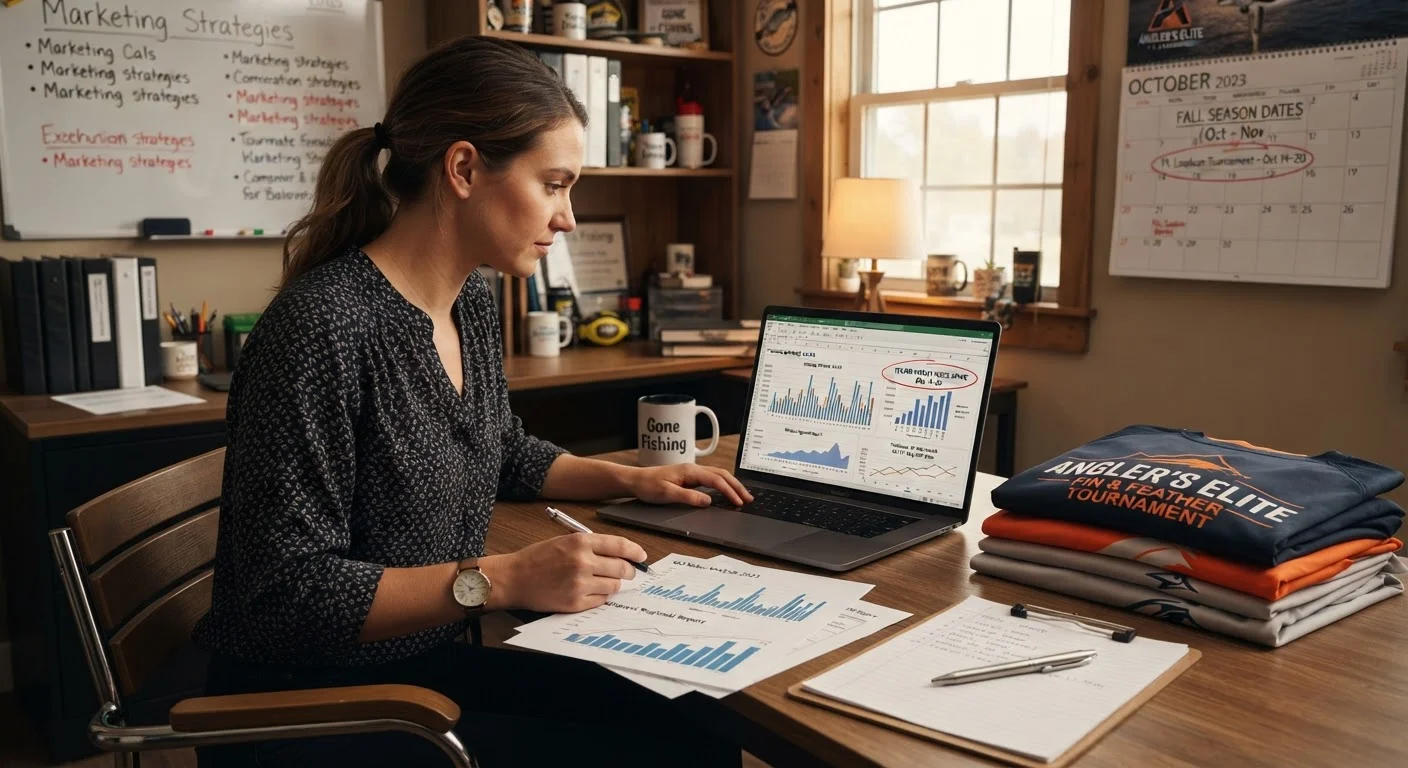
Most brands never look at their sales data before placing fall orders. Pull at least 2–3 years of sales data, not just last fall. Track the eight weeks before your peak season and four weeks after, by day or week. That way you spot patterns like a tournament week driving 2.5x your normal weekly volume.
Break It Down By Four Dimensions
Style SKU: Calculate revenue share per product. Your top 30–40% of styles by revenue are your "season stars." Forecast these first.
Size: Build a size distribution ratio (e.g., S: 15%, M: 35%, L: 30%, XL: 20%). Track stock-outs by size. Every day you were out of XL while orders kept coming in is a missed sale you can prevent this year.
Color: Corporate uniform orders skew heavily toward navy and gray, often over 70% of custom fishing team uniforms. Retail buyers are far less predictable.
Order Type: This is the one most brands skip. Separate retail (1–3 units/order), team orders (10–50 units, tied to tournament dates), and corporate custom orders (50–500+ units, tied to quarterly events).
Why This Matters For Lead Time
Team orders for fishing tournament apparel typically come in 14–45 days before use. Corporate custom can require 30–60 days. If you're still treating bulk order lead time the same across all three categories, you're setting yourself up for a scramble.
Build A Basic Forecast Formula
Take last year's volume, multiply by your baseline growth (5–8%), marketing expansion (5–10%), and team/fleet growth (10–20%). Stack those together and you're often looking at +30% or more in total demand. That's information you need locked in before you call your custom fishing gear supplier.
Step 2: Set Minimum Stock, Maximum Stock & Reorder Point (ROP) For Each SKU
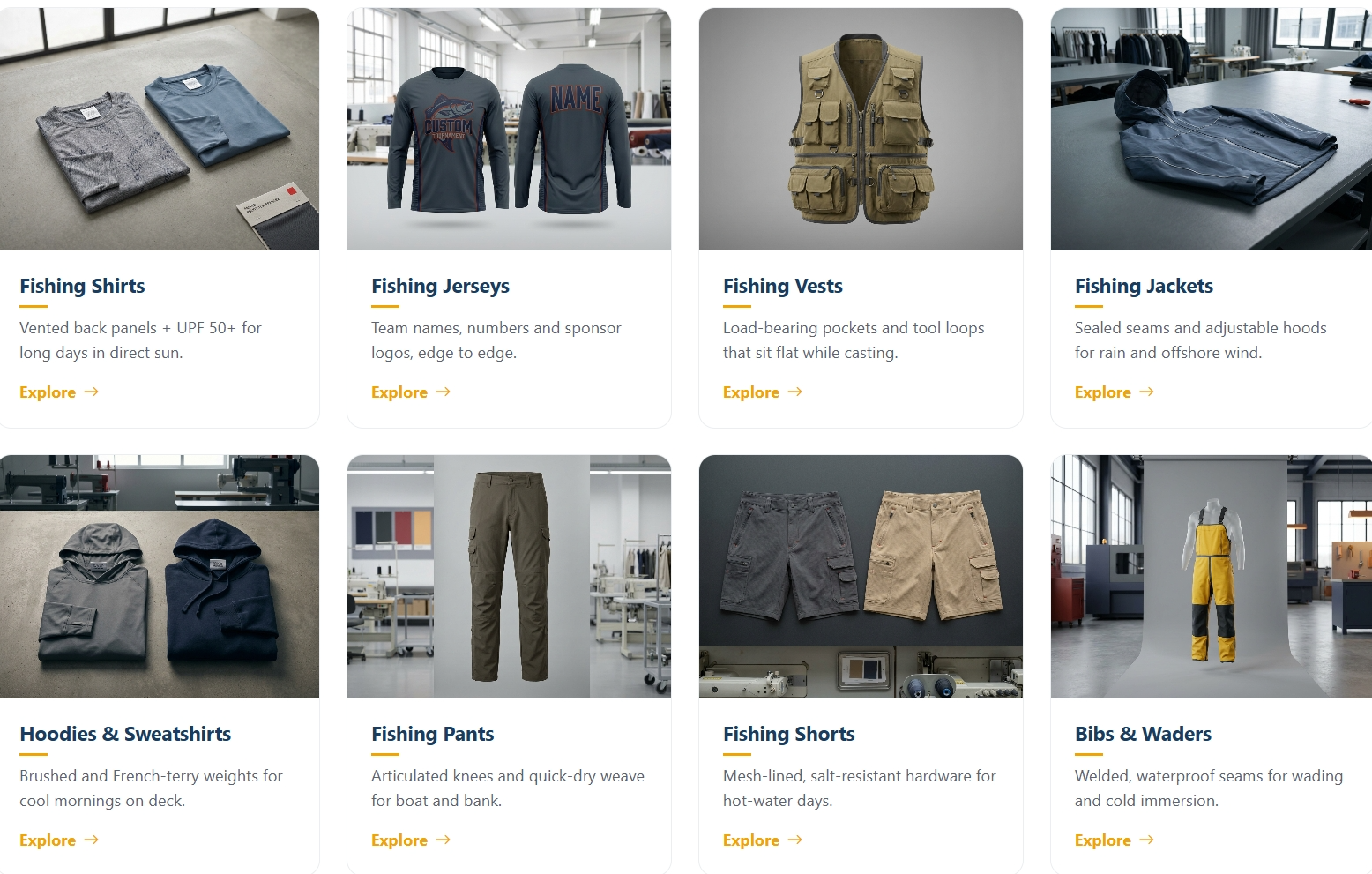
Numbers make this step simple. Once you have your forecast from Step 1, plug it into one formula: ROP = (Average Daily Demand × Lead Time) + Safety Stock.
Say you sell 20 units a day, your custom fishing gear wholesaler needs 12 days lead time, and you want a 100-unit buffer. Your ROP is 340 units. Hit that number in stock, and it's time to reorder—no debate, no guessing.
Don't Treat Every SKU The Same
Your bestsellers need tighter math than your slow movers. For high-volume styles, use: Safety Stock = (Max Daily Sales × Max Lead Time) − (Avg Daily Sales × Avg Lead Time).
Example: a core team uniform style sells 25 units a day on average, spikes to 45 a day during tournament season, and lead times range from 12 to 18 days. That's Safety Stock = (45×18) − (25×12) = 510 units. Bump that by 30% for a 99% service level, and you're carrying 660 units of safety stock. Your ROP lands at 960 units. Set Min at 960, and Max at roughly double that—around 1,920 units.
For niche sizes or low-volume colors, skip the complexity. Safety Stock = 0.5–1.0× your lead time demand is enough. Overbuilding buffer stock here ties up cash in inventory you don't need.
Run This In A Spreadsheet, Not Your Head
Build one tab with columns for SKU, average daily sales, max daily sales, lead time, and current stock. Add a status formula: IF(Stock<=Min,"REORDER","OK") . This turns seasonal inventory forecasting into a five-minute weekly check instead of a guessing game every fall.
Step 3: Build A Backward-Planning Timeline From T-12 Weeks To In-Season
Twelve weeks feels like plenty of time until you map out every milestone between “let’s do this” and “shirts on anglers’ backs.” Work backward from your target in-season date, and that runway looks a lot shorter.
T-10 to T-12 Weeks: Lock Budget & Product List
Allocate 40–60% of projected fall revenue toward first-batch stock. Cap your core SKUs at 20–30 styles max. Anything more creates chaos. Finalize 70–80% of your core lineup before hitting T-10.
T-8 to T-9 Weeks: Confirm Design & Tech Pack
This is where custom fishing clothing supply chain planning either holds or breaks. Budget 3–7 days for internal design approval, then 3–7 days for sampling. Cap revisions at two rounds, 3–5 days each. One core team uniform style went through three rounds last season, costing the brand nine extra days it never got back.
T-6 to T-7 Weeks: Submit Your Purchase Order
First-batch quantity equals predicted 4-week demand times a 1.2–1.3 safety factor. For new styles, dial that back to 70–80% of forecast. Leave room to reorder once real data comes in. Lock final pricing and lead time with your custom gear supplier here. Add a delay clause with a 0.1–0.3% penalty per late day to keep everyone accountable.
T-3 to T-4 Weeks: Reorder & Fine-Tune
Bestsellers get 2–4x your trailing two-week sales as reorder volume. For slow movers, cap reorder volume at 1–1.5x. This is your last real window before in-season chaos hits.
In-Season: Weekly Sell-Through Checks
Track sell-through weekly. If you hit 50%+ in the first two weeks with under 14 days of cover left, reorder immediately. If below 20%, hold.
Step 4: Create A Pre-Order Checklist To Run Before Every Reorder Cycle
Six items get skipped every single fall, and each one causes a different kind of delay. Run this checklist before you release a single PO to your custom gear supplier.
Demand & Inventory
Pull current run rate, open pre-orders, and confirm on-hand plus inbound PO units. Set your ceiling: PO quantity minus 10–15% safety stock minus 5–6% cancellation buffer. Add 7–14 days to every customer-facing date. Skip this, and late-shipment complaints follow.
Pricing & Supplier
Recheck margin if freight, cost, or lead time shifted since last cycle. Get supplier capacity, ship date, and MOQ pricing tier in writing, not a verbal "should be fine."
Brand Consistency
Pantone codes and material specs need sign-off before production starts. This is the single most common cause of custom team uniforms getting delayed for rework. Match product pages, size charts, and checkout terms to what you can actually deliver.
Assign Ownership
Give each field an owner: inventory, supplier, finance, brand approval, final sign-off. One shared document, one pause rule: if any field isn't green, the cycle doesn't launch. That's how bulk order lead time surprises stop happening.
Step 5: Choose and Lock In a Fall Production Slot With Your Custom Apparel Supplier
Fishing apparel factories fill their fall calendars faster than most brands realize. August and September are peak season for custom apparel supply chain planning: new school year, tournament circuits ramping up, corporate uniform refreshes. Popular production lines often hit 80-95% capacity 30-45 days before the rush even starts. Miss that window, and your "35-day lead time" becomes 55 days.
Work Your Timeline Backward From Launch
To have product live by early September, count backward. Shipping eats 25-40 days by sea (or 5-10 by air), production takes 30-45 days, and design/tech pack approval needs 10-20 days. That puts your supplier decision deadline at late May to mid-June, with contracts signed and deposits paid by late June.
Evaluate Suppliers On Hard Numbers
Ask any custom fishing gear supplier for specifics:
Fabric performance : 100% polyester knit, 130-180gsm, with WVT test data (≥5000 g/m²/24h) proving actual moisture-wicking
UV protection : UPF50+ reports using AATCC 183 standards
Sublimation quality : Colorfastness rated ≥4 on ISO 105-C06, printed at 200-210°C for 40-60 seconds consistently
Saltwater durability : Ink that survives 72+ hours of salt spray testing (ASTM B117) for fishing tournament apparel that holds up on the water
Track record : 3-5 previous fishing or outdoor brand projects, ideally with tournament teams or guide services
Compliance : ISO 9001 certification, OEKO-TEX Standard 100, defect rate under 3%
Lock The Slot With What You Offer
A 30% deposit gets you in line. But what really matters is what you offer in return:
Share your full-year forecast. That shows you're committing to 1,500+ units annually, which gets you priority over one-off orders.
Propose a rolling schedule—Q3 and Q4 batches instead of a single PO. Factories protect production lines for repeat business.
Lock fabric early. Committing to 50-70% of projected fabric usage upfront (even before final garment quantities) buys priority scheduling.
Get a written Gantt-style production schedule that includes fabric arrival date, sublimation window, cutting/sewing/finishing timeline, and confirmed ship-out date.
Build In Accountability
Write penalty clauses into your contract. If delivery slips past 7-10 days, negotiate compensation—air freight cost-sharing or a 2-5% unit discount. That makes both sides treat the deadline as real.
At CustomFishingWear.com , we run design mock-ups in 3-7 days and physical samples in 7-10 days, so brands can hit these tight fall windows without sacrificing fit or print quality.
Step 6: Set Up A Repeat Order Template System For Fast Reordering
Most brands re-enter design details every single reorder. That's wasted time you don't have during fall crunch. Build a template that locks your design and leaves only quantity and date open.
What Gets Locked
Pantone codes, logo file version, logo placement, print plate ID, MOQ, and vendor details all get saved once. No re-sending "PANTONE 286 C, top center, 15mm margin" every cycle. This single change protects your custom fishing team uniforms from rework delays.
What Stays Variable
Only two fields change per cycle: quantity and delivery date. Update those, hit generate, done.
Run A Pilot First
Pick one SKU you reorder monthly or quarterly. Build the template, bind it to your custom gear supplier, and run it through 2–4 cycles. Track how fast you go from "need more stock" to "order placed," and count how many emails you send confirming design specs. Most brands see email volume drop 50%+ once locked fields are in place.
Prove it works on one SKU, then roll the same structure across your full lineup. That's how apparel inventory management stops being a fire drill every September.
Step 7: Automate Inventory Tracking With Alerts & Simple Tools
Nobody has time to check stock by hand during fall crunch. Manual tracking fails then, and orders slip through the cracks.
Pick Your Tool Based On SKU Count
If you have 50–500 SKUs with a 1–3 person purchasing team, Google Sheets or Excel works fine. Office costs a few dollars a month; Google is free. Sync your Shopify or WooCommerce inventory into a sheet through Zapier, updating hourly or daily. Selling on Amazon, Walmart, and eBay? Route everything through Sellbrite or Ecomdash first, then import daily.
Set conditional formatting so rows where stock drops to or below your ROP turn red. Start with your top 10–20 SKUs, then expand.
Managing 200+ SKUs across multiple warehouses or channels? Move to a low-code tool like n8n or Clappia. These run $10–50 per user monthly, covered by one or two orders' margin. They compare stock to ROP in real time and push alerts through email, Slack, or mobile.
Build Your Alert Logic
Two conditions trigger every alert: current stock ≤ ROP, and no alert sent for that SKU in the last 24 hours. This prevents alert fatigue while catching real shortages. Scan fast-moving styles hourly, slow movers every 4–6 hours. Run one full inventory sweep every morning at 6 AM before your team starts placing orders.
Track The Right Fields
Your sheet needs SKU, item name, current quantity, ROP, lead time, standard order quantity, unit cost, preferred supplier, and last alert date. That last field stops you from spamming your team about the same low-stock item three times a day.
Route alerts to the right person. Assign a category owner for tournament apparel and a separate one for corporate uniform stock. When automation flags a shortage, they get a draft order with quantity and total cost already calculated.
Step 8: Review, Adjust & Optimize Your System After Each Fall Season
Fall season ends, and most brands close the books without a second look. Your reorder system only gets smarter if you feed it real data every year.
Compare Four Numbers For Every Core SKU
Pull forecast vs. actual sales, stockout days, order delay rate, and whether anyone manually overrode your system mid-season. Look at them side by side.
Forecast vs. actual : Check MAPE and bias by SKU, by week. Overestimated a style three seasons running? Cut its target inventory next year. Underestimated? Raise safety stock now.
Stockout days : Don't just count days out of stock. Check if stockouts clustered during peak weeks or lead time windows. High-margin SKUs with frequent stockouts need a higher ROP.
Delay rate : If delays concentrate around one supplier or category, fix that supplier relationship. Don't adjust your entire apparel inventory management system for one bad actor.
System overrides : Find every manual override, disabled reorder rule, or default reset. Version your parameters. Log who changed what and why.
Adjust Min/Max And ROP By Tier
Stockouts repeated? Raise your minimum to cover longer lead times, raise max to cover peak demand. Overstock sitting in the warehouse? Lower max first—don't gut your minimum and risk running dry.
Recalculate ROP using predicted lead-time demand plus safety stock. If actual lead times ran longer than planned, push ROP up.
Split your approach: A-tier bestsellers get tighter service levels and higher ROP. B/C-tier SKUs get wider bandwidth, lower carrying cost. One-size-fits-all inventory rules waste cash on slow movers and starve your best sellers.
Avoid The Two Most Common Traps
Overstocking every SKU "just in case" ties up cash and creates spring markdown headaches. Setting safety stock too low to save money backfires when your ROP triggers too late for reorders to land on time.
Before next fall's rush, run a full parameter backtest. Confirm nothing got overridden, reset, or left on default. This is where customfishingwear.com becomes a real partner—we help brands review season data and rebuild sharper reorder triggers before the next cycle starts.
Conclusion
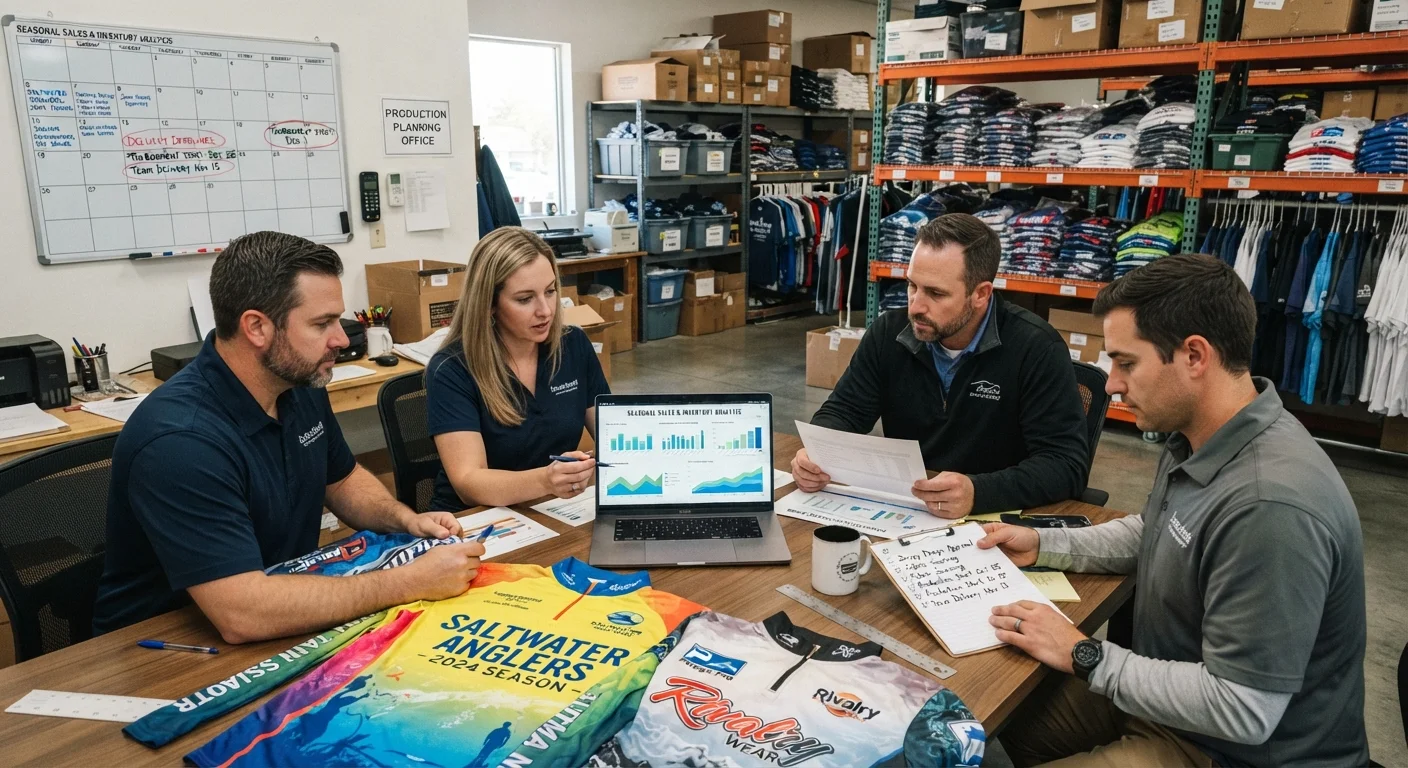
Fall season demand rewards teams that already have a system running.
Auditing last season's data, locking in production slots, and automating your alerts are all part of a custom fishing apparel reorder system. That system turns guesswork into a repeatable process. You plan around bulk order lead times without panic.
The teams, guides, and brands that win this fall treated reordering like a business function.
Pull your sales data today, map your T-12 timeline, and reach out to a custom gear supplier who understands fishing apparel, like the team at CustomFishingWear.com, to lock in your production slot before the calendar makes the decision for you.